2026 New Year Brief |Innovation as Strategy in an Age of Systemic Competition
As the world enters a new phase of global transformation, science, technology, innovation, and artificial intelligence (STI/AI) have moved decisively beyond the realm of economic development policy. They now sit at the core of national strategy, shaping how states organize power, manage risk, sustain legitimacy, and position themselves within an increasingly fragmented international system.
The past decade has witnessed the proliferation of national STI and AI strategies across major economies. From China’s articulation of science and technology as a foundation of national rejuvenation, to the United States’ security-inflected innovation governance, the European Union’s rule- and values-based approach, South Korea’s coordinated industrial upgrading, India’s scale-driven digital ambitions, and Qatar’s knowledge-economy diversification efforts, these strategies reflect far more than technical priorities. They reveal how states interpret the future, assess uncertainty, and recalibrate their long-term trajectories amid geopolitical tension, technological disruption, and environmental constraints.
However, public discussion of STI strategies often remains fragmented—treated either as economic planning, industrial policy, or technology governance. What is frequently missing is a strategic intelligence perspective: an approach that reads these strategies not only for what they propose, but for what they imply about national intent, coordination capacity, risk tolerance, and systemic ambition.
National STI strategies now define the “rules of engagement” of global competition. States are revealing not only what they want to build—but what they are willing to protect, trade off, or abandon. Drawing on a comparative analysis of formal national STI and AI strategies across China, South Korea, India, Qatar, the United States, and the European Union, the analysis applies an integrated strategic framework that connects four analytical layers of Meta-Geopolitical Capacities for Qualitative and Innovation-driven Growth :
... explores how the Fourth and Fifth Industrial Revolutions have reshaped the economic and political landscapes, emphasizing the importance of technological advancement, cross-sectoral collaboration, and multi-stakeholder synergy through the expanded Quintuple Helix model...
(1) meta-geopolitical capacities that define national power and resilience;
(2) governance architectures that determine coordination and execution;
(3) industrial competitiveness logics shaped by sustainability and circularity; and
(4) entrepreneurship models that translate strategy into innovation practice.
As a New Year Brief, this analysis presents a strategic comparative analysis of national Science, Technology & Innovation (STI) and Artificial Intelligence (AI) strategies across nations. The selection of six cases is deliberate and analytically significant, as these cases collectively represent the typical spectrum of contemporary STI and AI strategy formation in the context of global systemic competition. China and the United States constitute the principal poles of technological and geopolitical rivalry, shaping global norms, supply chains, and security logics. The European Union represents a distinctive regulatory and values-based innovation model, exerting influence through standards, sustainability governance, and international rule-making rather than solely through technological dominance. South Korea exemplifies a highly coordinated middle-power strategy that integrates industrial upgrading, alliance positioning, and technological specialization. India illustrates a scale-driven and demographically anchored innovation trajectory with high growth potential but heterogeneous governance capacity. Qatar, as a small but capital-rich and diplomatically active state, offers insight into how emerging knowledge economies leverage targeted STI investment and international connectivity to compensate for structural constraints. Therefore, these cases enable a structured comparison across different sizes, governance systems, development stages, and strategic roles, allowing this study to identify how national STI strategies function as instruments of power, coordination, and long-term positioning within the evolving global order.
By combining innovation studies with intelligence analysis, capability assessment, intent inference, governance mapping, and strategic risk evaluation, this analysis clarifies how different systems pursue advantage through distinct configurations of power, values, institutions, and agency. In an era marked by fragmentation and rapid technological change, the ability to interpret STI strategies as instruments of global strategy is no longer optional—it is essential for more informed dialogue, deeper comparative understanding, and a renewed appreciation of innovation as a central arena of global strategic interaction.
Introduction Across Major Strategic Actors
People’s Republic of China
China frames scientific and technological advancement as a foundational strategy for national rejuvenation and China’s long-term development vision. Since the 18th National Congress in 2012, China’s leadership has prioritized an innovation-driven development strategy and established the goal of building China into a country strong in science and technology by 2035, positioning science and technology as core drivers of economic strength, national security, and comprehensive national power.
At the heart of the strategy is an emphasis on strategic science and original innovation. China highlights breakthroughs in basic and frontier research—spanning quantum technologies, life sciences, materials science, and space science—as evidence of progress, while acknowledging that China still needs to strengthen its capacity for original scientific contribution and high-end innovation. It underscores a conscious shift toward measures to foster world-class research capabilities, including deeper structural reform of science and technology management, international cooperation, and the cultivation of high-caliber scientific talent.
Strategic science is further defined as both foundational and forward-looking. The speech delivered by President Xi in 2024 advocates:
Striving to Build a Country Strong in Science and Technology
- advancing basic research and theoretical discovery,
- achieving breakthroughs in core technologies that underpin key industrial and security domains,
- expanding China’s influence and leadership capacity in global science and innovation,
- building strong scientific talent pipelines, and
- strengthening governance systems to support efficient, coordinated scientific effort.
In essence, China positions strategic science as a national priority tightly integrated with economic, security, and societal goals. It calls for targeted investment in critical areas such as integrated circuits, AI, next-generation information technologies, advanced materials, and biotechnology—while promoting greater coherence between education, research, and industrial application to sustain long-term innovation capacity. China's push to become strong in science and technology within the broader systemic context of the global scientific revolution and international competition, asserting that frontier technologies such as AI, quantum science, and biotechnology are reshaping the global order and that China must rapidly deepen structural reforms to fully mobilize innovation resources and personnel. It outlines a dual approach combining unified Party leadership with market mechanisms, enhanced coordination across universities, enterprises, and research institutes, reform of evaluation and governance systems, and expanded openness to international cooperation while balancing self-reliance—emphasizing that cultivating talent, supporting enterprise-led innovation, and strengthening global scientific partnerships are essential to achieving the 2035 strategic objective.
Republic of Korea
South Korea has developed a comprehensive pan-government national strategy to nurture strategic technologies, directed at securing economic competitiveness and technology sovereignty. This plan involves:
- A National Science Technology Advisory Board chaired by the President to set strategic priorities across government, academia, and industry.
- Identification of 12 National Strategic Technologies (e.g., 5G, quantum computing, AI, advanced manufacturing) with targeted R&D investment and policy support.
- Legislation such as the Special Act on the National Strategic Technology to institutionalize governance, R&D incentives, talent cultivation, and international cooperation.
AI and Innovation Ecosystem Plans
In 2025, South Korea established a National AI Strategic Committee as a central policy coordination body, aiming for the country to become a top-three global AI power with an AI innovation ecosystem, data infrastructure, and national transformation goals.
Research Funding and Policy
Recent government announcements outline significant increases in research spending focused on AI, advanced computing, and strategic industries, reaffirming long-term innovation priorities.
Comparison with China
While South Korea’s strategy is more formalized in plans and institutional frameworks rather than a single national speech, it similarly prioritizes strategic technologies and innovation for national competitiveness, linking policy design with economic and security concerns.
United States
National Security Strategy (2025)
The U.S. 2025 National Security Strategy articulates a broader national interest framework. It emphasizes the foundational role of science, technology, and innovation in national power and security (e.g., maintaining leadership in critical emerging technologies). . It emphasizes
National AI and R&D Plans
The U.S. government (e.g., White House via America’s AI Action Plan and its National AI R&D Strategic Plan) has released formal AI strategy documents that guide federal research investments, innovation infrastructure, and adoption across sectors.
These plans include:
- A focus on accelerating AI research and adoption.
- Coordination across federal agencies and with the private sector.
- Emphasis on maintaining global leadership through market-driven innovation.
Standards and Critical Emerging Technologies
Entities like NIST (National Institute of Standards and Technology) provide strategic priorities for U.S. leadership in critical and emerging technologies (e.g., AI, quantum, biotech, semiconductors).
Comparison with China
The U.S. approach is more decentralized and market-driven, with government frameworks guiding rather than centrally directing all aspects of science and technology. It is formalized through policy documents, executive orders, legislation (e.g., Innovation and Competition Acts), and agency strategic plans rather than a central “nation-building” speech.
European Union
EU Strategy on Research and Innovation
The European Union has an overarching Strategy on Research and Innovation that outlines how research and innovation will:
- Support digital and green transitions.
- Strengthen European sovereignty in digital, data, and innovation sectors.
- Promote economic and societal resilience and global engagement.
European Strategy on Research and Technology Infrastructures
In late 2025, the European Commission adopted a long-term strategy focused on building world-class research and technology infrastructures, facilitating access for researchers, attracting talent, and strengthening international scientific collaboration.
Comparative Nature
The EU’s strategy is policy-document-based and institutionalized through multi-annual programming (e.g., Horizon Europe), and is not delivered as a single speech but is strategically integrated into legislative and budgetary frameworks.
Qatar
Qatar National Vision 2030
Qatar’s long-term development framework — Qatar National Vision 2030 — provides broad strategic guidance for economic diversification, human capital development, and knowledge economy goals, which imply the importance of science, technology, and innovation as underlying drivers.
Character of Qatari Strategy
Qatar’s science and technology strategy tends to be embedded within broader national planning frameworks and sector-specific strategies rather than in standalone high-profile speeches — but it serves similar purposes by guiding national innovation goals.
India
India’s national approaches to science, technology, innovation, and AI encompass several complementary policies:
National Strategy for Artificial Intelligence (2018) — initially framed under NITI Aayog, this strategy emphasizes using AI to address development challenges and promote AI for All. It prioritizes AI applications across health, agriculture, education, and infrastructure while building foundational research and innovation capabilities.
IndiaAI Mission & Governance Framework (2025) — India’s updated AI governance guidelines adopt a “light-touch, risk-based” approach that balances innovation with ethical, transparency, and accountability principles. This complements India’s digital ecosystem and national priorities like Viksit Bharat (Developed India).
Science, Technology & Innovation Policy (STIP, 2020) — this broader STI policy aims to strengthen India’s innovation ecosystem by connecting academia, industry, and government, supporting mission-mode R&D projects, and nurturing global competitiveness.
Primary goals. Use AI to solve societal challenges; build robust digital public infrastructure; democratize AI access; and promote innovation with ethical safeguards.
Although differing in institutional design, emphasis, and governance approach, these STI and AI strategies share a common purpose: to mobilize science and technology as foundational drivers of national resilience, competitiveness, and geopolitical influence. Each actor’s strategy provides insight into how innovation policy is being reconfigured as both an economic engine and a strategic instrument in a contested global landscape.
Comparative Analysis of Global STI and AI Strategies
The comparison also provides actionable insights into how STI strategies function as early indicators of geopolitical behavior, alliance formation, and systemic risk. As such, the analysis contributes not only to academic debates on innovation systems but also to strategic foresight, policy intelligence, and global governance discussions at a time when technological capability has become a decisive factor in international competition and cooperation. This comparative analysis offers a horizon-scanning perspective on how these regions design STI/AI policies as instruments of economic competitiveness and geopolitical strategy.
Meta-Geopolitical Capacities in National STI Strategies
National STI strategies are increasingly designed to enhance broad meta-geopolitical capacities – the foundational strengths that enable countries to compete and thrive. The comparison above illustrates that while all six actors recognize STI and AI as comprehensive strategic tools, they modulate their strategies to national contexts. For instance, social & health objectives are prominent in India’s and the EU’s plans (emphasizing inclusivity and public welfare), whereas China and South Korea – though also concerned with societal well-being – more explicitly frame tech innovation as a response to demographic changes (aging) and a means to improve social services efficiency. Political capacity (in terms of governance and autonomy) is a driving force in China’s and India’s self-reliance narratives, and in the EU’s quest for unity and strategic autonomy, whereas Qatar leverages STI mainly to reinforce its national vision and stability in a volatile region. The economic dimension is a common thread – all strategies are fundamentally aimed at growth and competitiveness – yet their approaches differ (e.g., the U.S. and EU rely more on private sector dynamism and market mechanisms, while China and Qatar lean on state-guided investments and plans). On environmental capacity, the EU stands out for embedding sustainability across its entire innovation agenda, essentially marrying green goals with industrial policy. In contrast, other countries still treat it as one priority among many (albeit growing in importance). For science and human potential, we see divergence in talent strategies: the U.S. and EU bank on attracting global talent and open science, China is rapidly building its domestic talent pipelines, and India and Qatar focus on education reforms and international partnerships to develop human capital. The military/security aspect is most pronounced in the U.S., China, and (to a lesser extent) India and Korea – linking STI to defense is a priority for the major powers, while the EU is cautiously stepping into defense R&D, and Qatar remains focused on internal security tech. Finally, in international tech diplomacy, all six recognize that leadership in STI confers global influence: the U.S. and EU currently set many of the norms, China is asserting itself with an alternative vision, and middle powers like India and Korea collaborate to amplify their voice in governance forums.
Notably, these capacity areas are interconnected, and differences emerge in how holistically the strategies address them. China’s and South Korea’s plans are perhaps the most integrated, linking scientific advancement to economic growth, social programs, and military strength in a unified narrative. India’s strategy is highly inclusive, socially and politically (bottom-up formulated), but faces challenges in execution across such a vast system. The U.S. has strong capabilities in each dimension but often treats them in parallel (e.g. separate initiatives for defense, climate, etc., coordinated loosely by OSTP). The EU’s strategy is comprehensive in principle (covering all seven dimensions across its policies). Yet, implementation depends on member states’ uptake – leading to strengths in environment and diplomacy, but persistent gaps in defense integration. Qatar’s strategy, while ambitious, must compensate for its small scale by heavily leveraging international scientific cooperation and a focused set of priorities (energy, health, etc.). These nuances underscore that a nation’s innovation strategy reflects its broader geopolitical circumstances and goals: STI is not developed in a vacuum but is explicitly harnessed to bolster national power and address perceived vulnerabilities.
Helix Governance Architecture and NGNI Alignment
A second analytical lens is the helix governance model, which assesses how well each strategy aligns multi-helix actors – government, industry, academia, and civil society – in a cohesive innovation ecosystem. An “NGNI-aligned” strategy involves not just the National government vision and Governmental agencies, but also Networked partnerships and Institutional (non-governmental, non-industrial) actors. We examine patterns of integration or fragmentation in each context:
China
China’s innovation governance is centralized yet broad-based. The national strategy is set at the highest level (the CPC Central Committee outlines S&T in the Five-Year Plans), ensuring a strong National directive. Governmental coordination is enforced through initiatives like the “whole-nation” R&D system which mobilizes ministries, local governments, and state-owned enterprises toward strategic tech goals (for example, multiple ministries jointly implement the AI Development Plan). Networked collaboration exists but is often state orchestrated: industry and academia are pulled into national mega-projects (e.g. semiconductor self-sufficiency) via funding programs and administrative guidance. Top tech firms are designated as “national champions” and expected to align with state goals (e.g. Baidu leading a national autonomous driving platform). Institutional involvement beyond industry – such as universities and research institutes – is significant, as China has expanded R&D at its universities and the Chinese Academy of Sciences; however, NGOs or civil society have a relatively minor formal role (apart from providing some science popularization), given the tight party-state control. Integration is high between government, academia, and industry (often through joint labs, talent programs, and public-private funds), but the model is top-down: the central government steers the helix, which limits bottom-up initiative from non-governmental actors. This approach has yielded clear direction and rapid mobilization (as seen in big projects like the Moonshot for AI chips), but it risks fragmentation along different lines: bureaucratic overlap and regional duplication can occur when everyone is tasked to innovate, and private creativity may be tempered by state oversight.
South Korea
Korea’s STI governance epitomizes Triple Helix collaboration (government–industry–academia) with increasing inclusion of a fourth helix (civil society where relevant, e.g. public engagement in consensus forums). The National level provides a guiding vision (the Master Plan, national AI strategy) which was notably formulated via an inclusive process involving all ministries and about 120 experts from industry, academia, and research institutes. This joint formulation indicates strong Governmental coordination – the existence of bodies like the Presidential Advisory Council on S&T (PACST) ensures ministries and agencies execute the plan in a synchronized manner. To break silos, Korea restructured its governance – for example, the presidential Fourth Industrial Revolution Committee was refocused into an AI-focused committee, chaired by the President, to oversee cross-ministerial AI policy. On the Networked front, South Korea actively involves the private sector and academia in implementation: there are public-private consultative groups so that industry needs feed into R&D programs, and major firms collaborate with universities on research (often co-funded by government). Specific policies support network integration, such as innovation clusters in regions (where local government, universities, and SMEs cooperate on specialized technologies). Institutional alignment is seen in how universities are being nurtured as research hubs and government research institutes (GRIs) given clear missions to avoid redundancy. Korea also solicits citizen input for agenda-setting (public hearings on the S&T plan) and addresses societal acceptance (e.g. an AI ethics framework with civic input). The overall pattern is one of integration: a relatively small country forging tight collaboration between government, industry, and academia. If any fragmentation exists, it might be between large conglomerates and smaller firms or between central and local innovation agendas – which the government is trying to mitigate by new coordination meetings and regional STI strategies. In summary, Korea’s helix governance is highly aligned, with robust institutions (MSIT ministry, PACST, etc.) connecting the helices, which has been credited with efficient execution of initiatives like its COVID-19 tech response and semiconductor R&D programs.
India
India’s STI governance has historically been government-centric, but the latest policy efforts strive for a decentralized, inclusive helix. The formulation of the 5th National STI Policy was unprecedentedly “Bottom-up, Decentralised, Experts-Driven, and Inclusive” – featuring nationwide public consultations, thematic focus groups, state-level consultations, and engagement with NGOs and industry. This participatory approach indicates a strong attempt to incorporate Networked input (from experts, private sector, and civil society) at the agenda-setting stage. In practice, however, implementation still relies on National and Governmental mechanisms: India has multiple agencies (Department of Science & Tech, Principal Scientific Adviser’s office, NITI Aayog for AI, etc.), and coordination among them can be a challenge. The STI Policy calls for creating an overarching STI Governance framework and perhaps a unified authority to align efforts, as well as STI units in each ministry and state government – a recognition that fragmentation exists across ministries and between central and state levels. Progress is being made: for example, the Empowered Technology Group (ETG) under the PMO helps coordinate emerging tech decisions across ministries, and the National Education Policy ties into STI goals, linking institutions. On the Institutional side, India boasts a vast network of national research labs, universities, and increasingly start-up incubators (often hosted at academic institutions). The new policy envisions an “institutional architecture to integrate Traditional Knowledge Systems and grassroots innovation with the overall research and innovation system”, which would bring community-level innovators into the helix formally. Industry’s role is growing through initiatives like public-private partnerships (e.g. the Semiconductor Mission inviting private fabs with govt incentives) and a government fund-of-funds for start-ups. Civil society and the general public are also drawn in for scientific temper and policy input – India conducts citizen science projects (like biodiversity apps) and has consultative bodies including NGOs for ethical debates (e.g. on AI in policing). Despite these efforts, fragmentation remains a challenge: funding is dispersed and often bureaucratic, and academia-industry links are weaker than in more developed systems (the policy explicitly aims to improve that). Nonetheless, India’s trend is towards greater alignment: e.g. missions like the vaccination program involved government labs, private pharma, and community outreach in tandem, showcasing a successful multi-helix mobilization. The hope is that new governance reforms (like the forthcoming National Research Foundation to coordinate research grants) will institutionalize a smoother helix integration going forward.
Qatar
As a small, centrally governed nation, Qatar’s STI governance is highly centralized but partnership-oriented. The National vision (Qatar National Vision 2030) provides top-level direction, and under it the Qatar Research, Development and Innovation (QRDI) Council acts as the principal Governmental body steering STI. The QRDI Council’s strategy was formulated through “extensive collaboration and consultation” among its members, many of whom come from academia (Qatar Foundation, etc.) and industry, indicating multi-helix input at the leadership level. Qatar explicitly embraces a “golden triangle” of government, industry, and academia as the foundation of its RDI ecosystem. For instance, Education City (with its cluster of international universities) interfaces with industries (through Qatar Science & Technology Park) under government funding – a clear triple helix model in a microcosm. The Networked aspect often involves international partnerships: Qatar leverages foreign institutions (universities, companies) as part of its innovation network, essentially importing expertise and collaborating on research. Institutional actors like NGOs are fewer (Qatar’s civic sector is limited), but entities like the Qatar Scientific Club or civil society groups in areas like environment do exist and can feed grassroots innovation ideas (though on a small scale). The government also encourages public engagement in science (for example, through science festivals and grants for youth innovation projects) as part of building a culture of RDI. Coordination is eased by Qatar’s size – key players are relatively few and often interconnected via the Qatar Foundation or the government. This means alignment is generally strong: initiatives (e.g. a new AI program) can be rolled out across ministries, academic bodies, and industry with high-level patronage ensuring cooperation. A potential weakness is over-reliance on centralized decision-making: if priorities are set from the top, some network actors might be passive. However, Qatar is mitigating that by setting up platforms like Qatar Open Innovation to solicit challenges from industry and invite global solvers. In sum, Qatar’s governance architecture is integrative, leaning on public-private-academic partnerships often facilitated directly by state-led institutions, with minimal fragmentation due to its cohesive vision and scale.
United States
The U.S. innovation system is highly decentralized and network-driven, with partial coordination through federal strategies. There is no single “national STI plan” akin to a five-year plan; instead, the White House (OSTP) periodically issues strategy documents and coordinates via the NSTC, but much decision-making and funding is distributed across multiple agencies (NSF, DoD, NIH, DOE, etc.), state governments, universities, and private firms. This fosters a vibrant Networked ecosystem: universities and industries collaborate organically (e.g. Silicon Valley emerged from a dense network of Stanford University, startups, venture capital, and federal research contracts). The National level provides broad priorities – for example, OSTP’s annual science budget priorities memo, or the new requirement for a quadrennial National Science & Technology Strategy by Congress – but it does not dictate specifics to the same extent as a centralized plan would. Governmental coordination exists in pockets: the NSTC subcommittees align federal agency efforts on specific topics (e.g. the Select Committee on AI brings together agencies to develop a cohesive federal AI R&D plan), and multi-agency initiatives (like the National Nanotechnology Initiative) create cross-cutting programs. Still, fragmentation can occur when agencies have overlapping or even competing programs. Efforts like the creation of ARPA-H (a new health advanced research agency) are intended to break silos by borrowing DARPA-like models. On the Institutional side, the U.S. heavily involves academia and nonprofit institutions in STI – universities perform a significant share of fundamental research (with autonomy to pursue diverse topics), and NGOs or expert bodies (e.g. National Academies of Sciences) frequently advise on policy. Industry is the dominant force in later-stage innovation; the government often takes a backseat after funding early R&D, allowing market competition to drive technology deployment. Civil society has a voice mainly through advocacy (e.g. civil liberties groups influencing AI ethics discussions) and through public comment processes on regulations. The U.S. innovation governance can be seen as organized chaos: a strong underpinning of networks and market mechanisms yields world-leading innovation outputs, but the lack of a single coordinating hand means priority alignment relies on soft coordination (e.g. agencies aligning to presidential memos) and the incentive structures of funding and regulation. A recent trend is the government using industrial policy tools (funding incentives in CHIPS Act, public-private partnerships for manufacturing institutes) to steer networks toward critical national goals, effectively trying to tighten the helix linkages in strategic areas without undermining the fundamentally decentral nature. In conclusion, U.S. STI governance is pluralistic and network-centric, excelling in harnessing diverse bottom-up innovation, though at times challenged by duplication and the need for mission convergence (which is addressed by initiatives like the Cancer Moonshot rallying multiple actors to a common mission).
European Union
The EU operates a multi-level helix – coordination is needed not only across different sectors (government, academia, industry, society) but also across member states. The EU-level strategy (e.g. Horizon Europe, Digital Strategy) provides a supranational National-level vision that complements national STI policies of member countries. Through the European Commission, Governmental alignment is pursued by encouraging national governments to adopt common goals (like the Digital Decade targets) and by co-funding programs. A prime example is the Coordinated Plan on AI which explicitly sought to “ensure that the EU acts as one” on AI, syncing national AI strategies with an EU-wide approach. Tools like the European Semester now include innovation indicators to nudge national policies. On the Networked dimension, the EU is a strong promoter of public-private partnerships (e.g. Joint Technology Initiatives in electronics, medicines, etc., where industry consortia work with EU and national funding). Cross-border networks are facilitated via instruments like EUREKA for industrial R&D collaboration and COST for research networking. Additionally, the EU involves Institutional and civil society actors extensively in policy-shaping: stakeholder consultations are mandatory in developing major initiatives, and bodies like the European Economic and Social Committee (EESC) give societal groups a formal say. The Quadruple Helix (adding civil society to the triple helix) is embraced in programs that demand societal engagement (for instance, Horizon Europe’s missions require citizen involvement in design and implementation of R&I to ensure uptake and acceptance). The presence of NGOs in areas like digital rights influenced the GDPR and AI Act proposals. The complexity of the EU system does risk fragmentation: member states differ in their innovation capacities and may pursue their own agendas (e.g. national research funding far exceeds EU funding, and countries like Germany or France have their distinct priorities). To mitigate this, EU initiatives like the European Research Area (ERA) aim to reduce duplication and “align national and EU research agendas”. We see progress in things like the synchronization of COVID-19 research funding across countries and the joint procurement of innovative health solutions. In summary, EU STI governance is consensus-driven and integrative, knitting together multiple governments and stakeholders. Its strength lies in orchestrating large-scale collaboration (no single European country alone could have built CERN or Airbus), and in setting common standards that unify the market for innovation. The trade-off is that reaching consensus can be slow, and initiatives must accommodate diverse interests, which occasionally leads to diluted ambition or delayed implementation. Nevertheless, when alignment is achieved – as in the Galileo satellite program or the upcoming EU Chips Act (with collective investment in semiconductor fabs) – the EU demonstrates a powerful helix alignment spanning many nations, industries, and institutions.
Integration vs. Fragmentation
Summarizing patterns, China and South Korea exhibit high integration internally (strong central coordination, clear roles for academia and industry), with China being more top-driven and Korea more consensus/committee-driven. India is moving from a fragmented, government-dominated model toward an integrated one by decentralizing input and encouraging state and private involvement, but it remains a work in progress with coordination mechanisms still solidifying. Qatar achieves integration by virtue of scale and central authority, incorporating external partners to fill gaps; fragmentation is low internally but capacity is concentrated in a few institutions. The U.S. has a different paradigm: integration happens through market and network forces rather than centralized planning – a strength for creativity and a weakness for directing efforts; fragmentation is managed by occasional federal interventions and a unifying culture of innovation in academia-industry linkages. The EU represents integration across boundaries – a slow but steady alignment process creating a meta-helix of nations, which is a unique governance experiment; fragmentation here means uneven participation by member states, something addressed by structural funds and inclusive policy processes.
In all, effective STI strategies require aligning the multiple helices of innovation. Those that have achieved clarity of roles and collaboration mechanisms (e.g. South Korea’s multi-ministry strategy with industry consultative committees, or the EU’s structured public-private partnerships) show more coherent implementation. Where alignment is lacking, strategies risk falling short: e.g. if academia isn’t incentivized to work with industry or if government efforts aren’t synchronized. Thus, helix governance is a critical determinant of policy success, translating strategic vision into on-the-ground innovation outcomes.
Circular Diamond Profiles of National Innovation Competitiveness
Each region’s STI strategy can be analyzed using an extended Circular Diamond model – which combines Michael Porter’s four determinants of national competitive advantage (factor conditions; demand conditions; related and supporting industries; firm strategy, structure, and rivalry) with two additional dimensions reflecting environmental sustainability and knowledge & innovation cycles. This “circular” diamond emphasizes not only traditional economic competitiveness factors, but also how well an economy regenerates resources and knowledge in a sustainable loop. Below, we compare how the strategies of China, South Korea, India, Qatar, the USA, and the EU strengthen each of these six facets:
1. Factor Conditions (Resources & Talent)
This refers to the quality of a nation’s inputs to innovation – human capital, research infrastructure, financial capital, and data/IT resources. All six actors prioritize factor development, but with nuances:
China
China has massively expanded its R&D infrastructure and talent base. Its strategy to “strengthen original innovation” entails heavy investment in universities, national labs, and basic research funding. China now spends over 2.4% of its GDP on R&D (with a plan to reach 3%+), and as noted earlier it leads the world in patent filings. The government also creates enabling data infrastructure – for example, building a “secure national integrated data market” to ensure abundant data for AI development. A possible weakness is quality: the strategy acknowledges need for “long-term, stable support” for fundamental research to produce truly groundbreaking innovation, moving beyond the quantity metrics.
South Korea
South Korea already has excellent factor conditions in certain respects (world-class universities, one of the highest R&D/GDP ratios ~4.8%, strong STEM workforce). Its Master Plan focuses on sustaining and improving these: addressing the “decreasing research population” via talent programs, and enhancing research environments (e.g. 10-year grants for researchers, sharing of equipment and data nationally to maximize use). Korea is also injecting funds into new strategic fields like space and biotech to build infrastructure there. A “mission-oriented R&D system” suggests allocating resources to key missions (such ashas historically underinvested in R&D (~0.7% of GDP) and faces“mission-oriented R&D system” carbon neutrality or chip leadership). Overall, Korea’s strategy is to maintain its factor strength by focusing resources (preventing dilution) and by bringing in needed foreign expertise (as discussed under human capital).
India
India has historically underinvested in R&D (~0.7% of GDP) and faces infrastructure gaps. The STI policy directly tackles this by proposing significant financing reforms. Every ministry and state must allocate a fixed STI budget, doubling central R&D spending in 5 years, and setting up an STI Development Bank for long-term innovation funding. These steps aim to expand financial and physical research infrastructure. India’s huge human resource potential is being cultivated through education and skill initiatives (as mentioned, aligning with NEP 2020, and creating new research centers of excellence). Additionally, India is improving its Adigital infrastructure (the Digital India program has brought broadband to villages, which the AI strategy notes as key for broad AI adoption). The factor conditions in India’s strategy emphasize inclusion – ensuring even smaller institutions and states build capacity, thus broadening the base of innovation.
Qatar
Qatar with abundant financial capital from energy exports, is translating that into knowledge infrastructure. It has invested billions into state-of-the-art research facilities (like Sidra Medical Research Center, Qatar Computing Research Institute) and into education (branch campuses). The QRDI 2030 outlines enabling elements: “RDI Funding” – creating a balanced public-private funding mix, “RDI Information Systems” – to better share knowledge resources, and “RDI Governance/Regulation” – to make the environment attractive for research talent and capital. Qatar’s small population means human capital is its scarcest factor; the strategy mitigates this by attracting foreign talent and upskilling citizens. It also focuses on niche excellence (e.g. specialized labs for LNG technologies, given its energy sector). Data and computing infrastructure are being addressed via initiatives like a national cloud and plans for data-sharing diplomacy. In summary, Qatar’s factor strategy is to convert wealth into intellectual capital and modern facilities, while partnering internationally to augment its limited human resources.
United States
The USA continues to enjoy extreme factor conditions – top universities, deep capital markets, large pools of data (due to its big digital economy), etc. U.S. strategy documents stress keeping this edge: for instance, the CHIPS and Science Act of 2022 not only funds chip fabs but also authorizes significant increases for NSF and NIST to enhance research capacity nationwide. There’s an effort to build manufacturing institutes (public-private centers for advanced manufacturing R&D) to update the physical infrastructure for innovation. The AI R&D Strategic Plan emphasizes ensuring computing resources for researchers (like shared AI testbeds) and expanding the AI-ready workforce. Moreover, American venture capital remains a critical factor input, and policies generally aim to encourage investment (through R&D tax credits, SBIR grants, bridging startups, etc.). The main challenges noted are talent shortages in specific fields (hence immigration reforms and STEM education boosts). But overall, U.S. factor conditions are robust, and policy is more about fine-tuning (e.g., increasing diversity in STEM, ensuring rural broadband, safeguarding research from foreign IP theft) than building from scratch.
European Union
The EU, across its members, possesses strong factor endowments in science (many excellent universities, skilled labor), but faces fragmentation and variation (R&D intensity ranges from ~0.5% to 3% of GDP across countries). The EU’s strategy tries to aggregate and elevate these factors: Horizon Europe provides a €95 billion collective research fund to supplement national investments, thereby creating large-scale projects none could do alone. The EU also invests in pan-European infrastructures – e.g. the EUROHPC initiative builds supercomputing centers accessible to all members, and ESA (European Space Agency) gives Europe shared space tech capacity. A flagship move to improve factors is the plan to train 20 million ICT specialists by 2030 and to have 80% of adults with basic digital skills (Digital Compass goals), directly addressing human capital needs. Financially, the EU is encouraging venture funding and integration of capital markets (traditionally a weak spot compared to U.S. VC availability). Additionally, recognizing data as a key resource, the EU is implementing the European Data Strategy to create common data spaces across sectors (while respecting privacy under the GDPR) – this is intended to improve the quantity and quality of data available for innovation in Europe (a factor critical for AI). In summary, the EU strategy for factor conditions is about scale and cohesion: pooling resources to act as one extensive innovation system and uplifting weaker regions through structural funds so that factor conditions are more uniformly strong across the Union.
2. Demand Conditions
Sophisticated and large local demand can spur innovation by giving firms an incentive to meet high standards and tailor products early. Each region’s approach to stimulating demand for innovation differs:
China
With 1.4 billion people and a growing middle class, China’s domestic market is a huge demand pull. The government actively leverages this: for example, public procurement and industrial policy favor domestic tech solutions (e.g. requiring government offices to use local software, which nurtures domestic IT firms). The strategy of “promoting deep integration between scientific and industrial innovation” and “accelerating the transformation and application of major S&T achievements” is essentially about turning research into products that meet market needs quickly. The mention of “boosting…Digital China initiative” and widespread AI adoption (with “AI Plus” penetrating key industries like manufacturing, finance, healthcare) indicate that China is pushing demand across sectors by incentivizing traditional industries to digitize and adopt AI. Additionally, Chinese consumers are often open to new tech (e.g. mobile payments, super apps), giving companies a large testbed. The New Generation AI Plan even set targets for AI usage in domestic public services. Thus, China’s strategy uses policy (like smart city programs, autonomous vehicle pilot zones) to cultivate home-market demand that gives Chinese innovators scale and experience before venturing abroad.
South Korea
Korea’s relatively smaller market (51 million people) is highly tech-savvy, providing a good environment for early adoption. The government’s AI strategy explicitly includes making “all industries” adopt AI and creating a “next-generation intelligent government” as a lead user. This dual approach – private sector adoption and government as model user – drives demand. For instance, Korea’s “Smart Factory” initiative prompted thousands of SMEs to implement IoT/AI solutions, spurred by government incentives. Demand is also bolstered by setting high standards (Korean consumers expect top-notch connectivity and devices – recall Korea’s early 5G rollout, which pushed telecom firms and device makers to innovate). Moreover, Korea leverages global demand in niche areas: e.g. it aims to be the world’s top AI chip provider for data centers, meaning it’s anticipating foreign demand and aligning domestic R&D to that. Domestically, cultural acceptance of new tech (e.g. delivery robots, digital banking) is strong, and the government nurtures that with public education on AI and some welfare AI solutions, to ensure society pulls innovation (people want it) as much as companies push it. Summarily, Korea’s demand conditions are enhanced through policy-orchestrated adoption programs and a populace eager for innovation – creating a virtuous cycle for companies like Samsung, LG, Naver to constantly develop advanced offerings for discerning local users.
India
India’s large population offers potentially huge demand, but low average incomes and varied regional needs make it a challenging market. The AI strategy notes that government must often drive initial adoption in sectors like agriculture and healthcare because private sector alone finds it not immediately profitable. Accordingly, the government has launched Digital India initiatives (e.g. building digital ID, digital payments which then enabled a boom in fintech innovation driven by citizen uptake). India’s STI approach to demand is twofold: identifying key areas of societal need where tech can have “the greatest externalities” (positive spillovers) – such as AI in agriculture (e.g. crop yield prediction systems for farmers) or healthcare (telemedicine for rural areas) – and then investing or partnering to implement solutions there; and raising the quality bar via standards and regulations in emerging sectors (for example, India is developing its own standards for drone safety, which pushes local drone startups to meet them and become globally competitive). The sheer size of India’s internal markets in sectors like telecom (over a billion mobile subscribers) also allows local firms to achieve scale – e.g. Reliance Jio’s 4G network rollout created demand for affordable smartphones and spurred domestic electronics assembly. Another example: the government’s push for electric vehicles has come through measures like the FAME subsidy scheme, which is now stimulating demand for EVs and in turn local manufacturing of EV components. However, India’s demand conditions can be hampered by limited purchasing power and infrastructural gaps. The STI policy is trying to improve that by inclusive innovation – making products extremely affordable (frugal innovation) to unlock mass demand, and by improving infrastructure (e.g. expanding broadband, power, etc.) so that more of the population can be active digital consumers. In essence, India’s strategy acknowledges demand won’t automatically rise to cutting-edge tech unless the state intervenes as a catalyst and enabler, bridging the gap until the private market matures enough to sustain itself.
Qatar
As a wealthy country with a small population (~3 million, mostly expatriates), Qatar’s domestic demand for high-tech products is niche but present – e.g. demand for smart city solutions in Doha, or advanced healthcare for its residents. The government often acts as the chief orchestrator of demand: for instance, it implements smart infrastructure (stadiums with IoT, government e-services with AI chatbots) thereby becoming the lead customer for new tech. The Qatar Digital Government initiative and the TASMU Smart City project create local markets for digital innovations in transport, logistics, health, and environment. Qatar’s AI strategy also envisions making the country a testbed where new AI solutions can be developed and then exported – the idea of “Qatar as an AI+X nation that others look up to”implies using domestic deployments (in education, business, government) to showcase what AI can do, thus generating both local and international demand. Another angle is international demand capture: Qatar encourages foreign tech firms and start-ups to establish presence in Qatar (e.g. through attractive business regulations in zones like QSTP). By doing so, Qatar imports demand – i.e. those companies bring projects and services that increase local innovation activity. Additionally, Qatar’s affluent consumer base can serve as early adopters for technologies like electric vehicles, luxury tech products, etc., though this is a small market. In summary, Qatar’s demand-side strategy is government-led – creating demonstration projects and living labs that generate a pull for innovation – with an eye to leveraging those successes to tap into global demand (especially in Gulf and emerging markets where Qatar could export its proven solutions in, say, desalination AI or sports tech after the World Cup experience).
United States
U.S. demand conditions are among the world’s most favorable to innovation: a large, wealthy market with consumers and businesses that enthusiastically adopt new technologies. The U.S. government generally doesn’t need to force demand in the private sector – instead, it often plays a role in setting aspirational goals and letting market forces respond. For example, the announcement of a nationwide EV charging network and future gasoline car phase-out by states like California sends a demand signal to automakers to innovate in EVs. The U.S. government is a massive buyer as well (federal procurement ~ $600B/year), and it uses that to create demand for innovation: e.g. the DoD’s contracts for SpaceX essentially helped create a new space launch market, and more recently, government commitments to purchase “American-made” clean technologies (like heat pumps, green steel) under climate initiatives aim to stimulate those nascent markets. Another mechanism is standards and regulations – for instance, the EPA’s tightening of emissions standards in vehicles pushed companies to innovate in fuel efficiency and now electrification. Consumers in the U.S. often set global trends (everyone wanted a smartphone after U.S. adoption soared). Importantly, the diversity of the U.S. market allows early adopters to form niche demands that grow – for instance, tech-savvy segments in Silicon Valley try new apps and devices, providing test markets. The U.S. also has strong venture capital which not only supplies funds (factor) but also pushes startups to achieve product-market fit, essentially ensuring they meet some demand. One area the U.S. strategy identifies to boost demand is infrastructure modernization – by deploying advanced infrastructure (smart grids, 5G, etc.), it creates platforms on which new services can be built and demanded. Additionally, American culture’s receptiveness to innovation (though tempered by recent privacy and ethical concerns) traditionally means if you build a better mousetrap, people will beat a path to your door – a healthy demand scenario. Summing up, U.S. policies focus on enabling conditions (e.g. antitrust to keep markets competitive, consumer protection to build trust in new tech, and sometimes subsidies to lower cost for first buyers) rather than direct government programs to adopt tech (except in defense and space). One exception is healthcare: the government via agencies like HHS is trying to spur demand for health IT and telehealth, as the private U.S. healthcare market has inefficiencies.
European Union
The EU has a large single market (~450 million people) with sophisticated demand shaped by high standards – often called the “Brussels effect” because EU regulations (on safety, environment, etc.) effectively set global benchmarks that companies innovate to meet. The EU’s strategy explicitly uses this as a lever: by aligning AI policy and preventing fragmentation, the EU wants to ensure a “first-mover advantage” in adoption of AI technologies. This includes coordinating public procurement of innovative solutions (e.g. joint procurement of AI systems for public sector across countries) and creating lead markets in areas like green tech (the EU’s Green Public Procurement tells governments to buy eco-innovations, stimulating those industries). European consumers are generally discerning about quality and sustainability, which creates demand for advanced products (like Germany’s demand for precision engineering, or Scandinavia’s demand for clean tech). The EU also fosters demand through pilot programs – for instance, the EU AI Testing and Experimentation Facilities (TEFs) allow companies and users in sectors like agriculture or healthcare to try AI solutions, seeding interest and trust. Another distinctive EU approach is regulatory-driven demand: e.g. banning certain less efficient or unsafe products (like incandescent bulbs, or soon, high-emission vehicles) thereby forces a shift of demand to innovative alternatives (LED lights, electric cars). While sometimes criticized for burdening companies, this method has spurred innovation aligning with those standards (Philips became a leader in LEDs, European automakers invest heavily in EVs to meet CO2 targets). Additionally, the EU tries to unify demand across member states – e.g. through the Coordinated Plan on AI, encouraging each country to roll out AI in public services, education, etc., so that there’s an EU-wide market that startups can scale across. Challenges remain: demand in the EU can be fragmented by language and cultural preferences, and European companies often scale up slower partly due to differences in consumer markets. The New European Innovation Agenda addresses that by aiming to create pan-European sandboxes where innovators can launch across multiple countries easily, thus aggregating demand. In summary, the EU leverages its large market and high standards to shape demand for innovation, and increasingly uses coordination and regulation to make that demand a springboard for its companies (exemplified by its push for “trustworthy AI” – setting rules so that consumers feel safe using AI, which should increase uptake of AI products under those rules).
The following radar charts provide a visualization of the Circular Diamond profile for the selected regions, highlighting their relative strengths in each of the six dimensions (values are illustrative, based on qualitative analysis of strategy priorities):
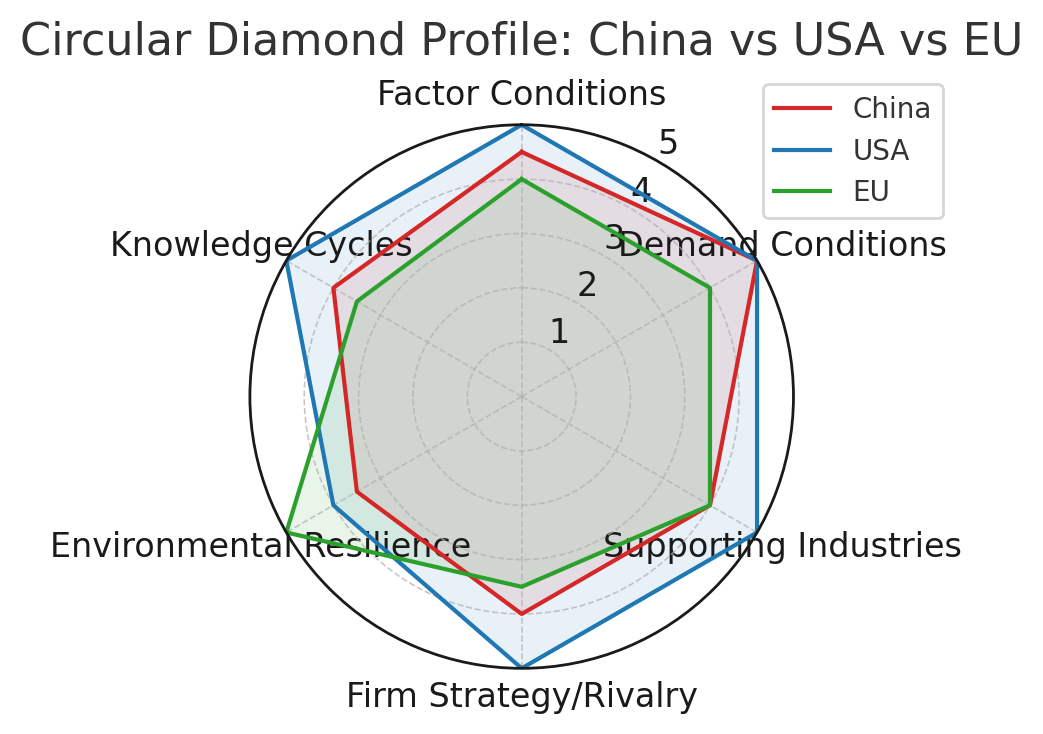
Circular Diamond Profile comparison for China, the USA, and the EU. Each axis represents one dimension (Factor Conditions, Demand Conditions, Supporting Industries, Firm Strategy/Rivalry, Environmental Resilience, Knowledge Cycles). A larger area indicates a stronger strategic emphasis/capability in that dimension. The USA (blue) shows balanced strength, especially in rivalry and knowledge flows; China (red) is strong in demand and factors but slightly less in environmental sustainability; the EU (green) excels in environmental resilience and maintains solid factors and demand, but has a smaller scope in firm rivalry (due to less dynamic startup scaling historically). These profiles reflect strategic focus: e.g., the EU’s deliberate emphasis on sustainability, China’s push for scale and self-reliance, and the USA’s entrenched competitive market system.
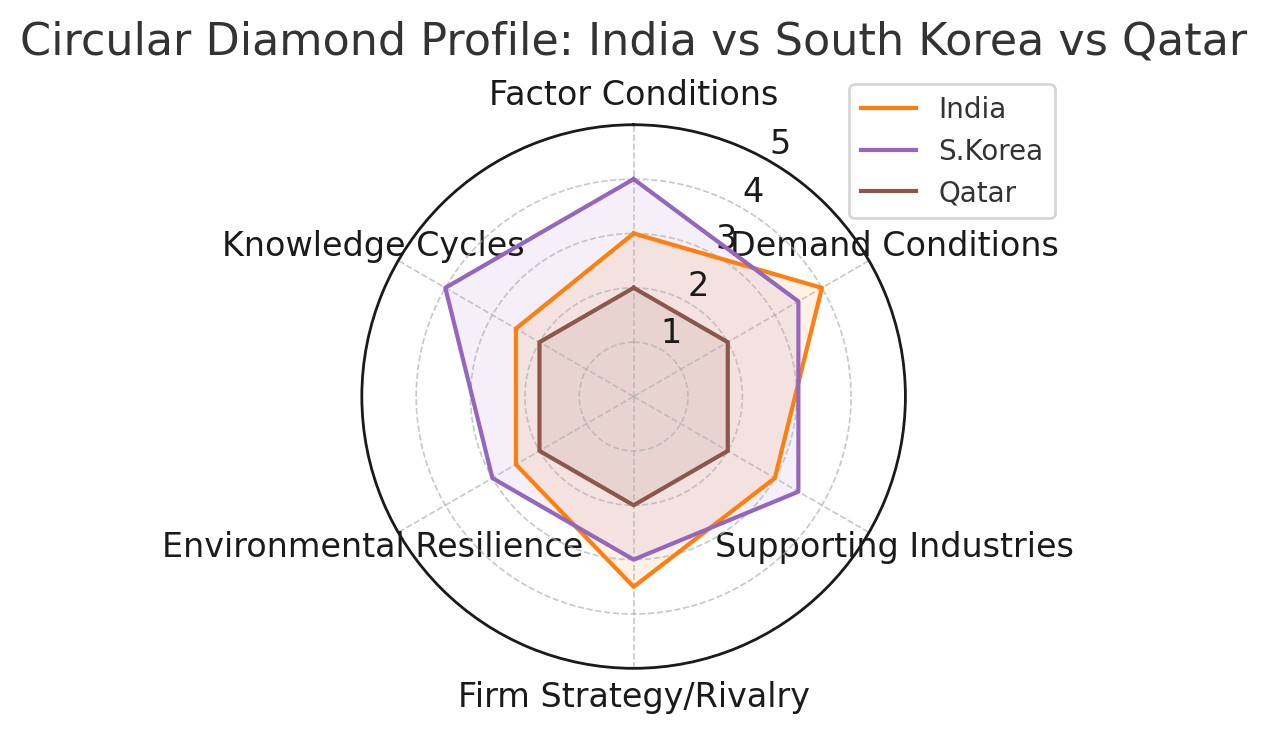
Circular Diamond Profile comparison for India, South Korea, and Qatar. India (orange) has improving factor conditions and demand (large market), but still weaker supporting industries and knowledge cycles (silos exist) – the strategy aims to bolster those via industry-academia links and supply chain initiatives. South Korea (purple) is strong in knowledge cycles and factor conditions (thanks to effective education and R&D systems) and is solidifying environmental resilience (carbon-neutral tech drive); its relatively lower demand score reflects market size, which Korea compensates by exporting innovation. Qatar (brown) has high investment (factor) but as a small economy it’s still developing depth in supporting industries and broad firm rivalry – its strategy leans on international linkages to improve those.
3. Related and Supporting Industries
A vibrant network of suppliers, service providers, and complementary industries fosters innovation through clustering effects. Strategies that promote clusters, SMEs, and linkages strengthen this dimension:
China
Recognizing that innovation cannot happen in isolation, China’s policy actively builds industrial ecosystems. For example, in semiconductors, it’s not just funding chip designers, but also upstream equipment makers, downstream assemblers, and establishing entire semiconductor parks. The push for “coordinated development of education, sci-tech and talent” also implies linking academia (as a supporting partner) with industry needs. China’s regional cluster strategy (e.g. Greater Bay Area for tech, Beijing for AI, Wuhan for optics, etc.) concentrates related industries together. It also uses standardization alliances and industry associations to bring companies together to solve common challenges (as seen in 5G, where a lot of Chinese companies and the government worked in tandem to push a homegrown standard). By nurturing not just champion firms but also their suppliers (often via subsidies and local content requirements), China has grown more complete supply chains – for instance, domestic battery makers (CATL) rose alongside the EV industry due to supportive policies linking auto and battery sectors. Additionally, big tech firms are encouraged to develop platforms that support smaller businesses (AliCloud enabling countless start-ups). Overall, China’s strategy creates dense supporting networks – albeit sometimes this means duplication in different provinces racing in the same sector, which the central government is now trying to coordinate better.
South Korea
In the past, Korea’s innovation was heavily centered on chaebols (conglomerates) with less developed supplier SMEs (often Japanese or foreign suppliers). Recent strategy addresses this by strengthening SME innovation and industry linkages. The Master Plan introduced programs like the “five-stage tailored innovation support for business-affiliated research institutes” to upgrade R&D at smaller firms and link them with larger companies. Also, “industry-specific private R&D cooperation committees” are established to ensure industry players and government jointly plan R&D to fill supply chain gaps. For example, after Japan’s export curb on materials in 2019, Korea launched initiatives to develop local chemical and materials suppliers – now it’s seeing a burgeoning of those supporting industries. Tech clusters in Korea (e.g. Pangyo Techno Valley for ICT start-ups, Daedeok Innopolis for research institutes) foster close interaction between related firms, universities, and startups. The innovation policy also encourages spillovers from big firms: large companies are nudged to open their procurement to startups (so a Samsung might incubate component suppliers). The concept of “Regional Innovation” in the plan – each province having R&D hubs for its focus industries– further bolsters local supporting networks (e.g. a machinery hub in Busan, biotech hub in Daejeon, etc.). In sum, Korea is moving from a top-heavy industrial structure to a more networked one, with policy bridging chaebols and SMEs, and promoting ancillary industries (such as the government-backed automotive parts clusters now transitioning to make EV parts).
India
India’s supporting industry networks are patchy – there are some strong clusters (Bangalore for IT, Pune for auto, Hyderabad for pharma-biotech) but also large parts of the economy not well integrated into innovation supply chains. The STI policy addresses this by fostering clusters and technology parks. There are proposals for Science & Technology “City” clusters in major metros to bring research institutions, industries, and start-ups together. The government also supports Sectoral Innovation Councils in areas like fintech, biotech, etc., to align industry and academia efforts. For MSMEs, the Innovation policy and Startup India campaign provide networking platforms (e.g. the Startup Hub connects entrepreneurs with mentors, corporates, and investors). In manufacturing, the Production-Linked Incentives (PLI) schemes (outside the STI policy but aligned in spirit) are creating entire ecosystems – e.g. in electronics, PLI incentives have drawn not just assemblers like Foxconn, but also component makers to set up in India, thereby building a local supply network. Moreover, India is leveraging its big IT services sector to support other industries’ innovation – IT firms partner with, say, agriculture start-ups to provide tech backbone (like TCS supporting agritech incubators). An interesting supporting industry angle is traditional industries and crafts: the STI policy wants to integrate traditional knowledge systems with modern innovation, which could mean boosting rural artisan clusters with design/marketing innovation, connecting them to global markets (this improves socio-economic impact and sustains diverse supporting sectors). Challenges remain in fragmentation and coordination (the policy highlights the need for better “interconnectedness and collaboration” among different stakeholders). But initiatives like setting up Common Research and Technology Development Hubs (CRTDHs) for MSMEs in various sectors, and large missions (e.g. clean energy mission bringing together coal, renewable, auto industries for storage tech) are steps toward a more integrated supporting industry fabric.
Qatar
Given its narrow economic base historically (dominated by oil & gas), Qatar is essentially building supporting industries from scratch in its diversification journey. The QRDI strategy’s focus on five priority areas (Energy, Health, Sustainability, Society, Digital) is meant to concentrate efforts and create critical mass in those domains, with each priority bringing together multiple players. For example, in Energy, they encourage not just core oil/gas companies but also new firms in solar, carbon capture, and related engineering services to cluster in initiatives like Energy Hub at Education City. The Qatar Science & Technology Park (QSTP) is a classic cluster initiative where multinational tech companies, Qatari start-ups, and research institutes co-locate and collaborate (e.g. QSTP houses a tech venture fund, innovation labs, and offices of companies like Microsoft, creating a micro-ecosystem). Qatar also uses partnerships as a way to import supporting industries – inviting foreign universities or companies to set up R&D and incubators means they bring their supplier networks and expertise, which then local entrepreneurs can tap into. There is a drive for local supplier development in sectors like defense and healthcare, often through offset programs (foreign suppliers investing in local startups or training as part of contracts). A notable supporting sector Qatar is cultivating is ICT – through its digital agenda, it hopes to foster a domestic tech sector that can support all other industries via solutions (for example, a homegrown cybersecurity industry to support finance and government sectors). These efforts are nascent; Qatar’s innovation ecosystem is still small, so a few anchor institutions (like Qatar Foundation, and big state enterprises) play outsized roles in mentoring and supporting smaller firms. Over time, success would be a scenario where, say, a Qatari medical device startup finds local component suppliers and service providers, but currently many such inputs are imported. The strategy acknowledges this and hence emphasizes international research collaborations and knowledge transfer to seed local supporting industries.
United States
The U.S. has historically benefitted from extremely well-developed supporting industries across almost every sector. Silicon Valley is the textbook example: a dense network of suppliers (hardware, software, legal, VC, talent) supporting each other and spawning continuous innovation. U.S. policy typically doesn’t need to create clusters – they emerge and flourish organically due to market forces and prior public investments (like the internet, or the biotech clusters around NIH-funded university labs). However, recognizing some hollowing out in manufacturing supply chains (offshoring), recent policies aim to rebuild certain supporting industries domestically for resilience – e.g. initiatives to encourage domestic production of pharmaceutical ingredients (so biotech innovation isn’t entirely dependent on foreign suppliers), or the CHIPS Act funding not just chip fabs but also suppliers of semiconductor chemicals and tools to come to the U.S. (recreating a fuller local ecosystem). Additionally, the Manufacturing USA network (14 innovation institutes) explicitly connects large manufacturers, small suppliers, and academic experts in fields like 3D printing and robotics, to accelerate diffusion of new techniques among supporting firms. On a regional level, the Economic Development Administration runs Build Back Better Regional Challenge grants to boost innovation clusters in distressed areas (supporting industry development in places beyond the coasts). Moreover, U.S. antitrust policies historically ensured no single firm could dominate supply chains end-to-end, thus encouraging a competitive supplier base – this continues (though big tech’s ecosystem control is a new challenge). Another strength: robust professional services (consulting, design, marketing, VC, etc.) which support innovators – these flourish in the U.S. environment and are part of supporting industries that get less attention but are crucial. In summary, the U.S. strategy doesn’t explicitly focus on “supporting industries” because they are largely present – the focus is more on keeping them healthy through measures like SME support loans, R&D tax credits that small suppliers can use, etc. One area receiving new attention is workforce training as a supporting factor for industry – e.g. apprenticeships in advanced manufacturing to ensure skilled trades are available to support high-tech production.
European Union
The EU’s approach to supporting industries often involves cross-border clusters and industrial alliances. Recognizing that no single country might cover a whole value chain, the EU sponsors Important Projects of Common European Interest (IPCEI) – for instance, one on Batteries and one on Microelectronics – which bring together dozens of firms and research orgs from multiple countries to develop an entire supply chain (from materials to assembly) in Europe. This is directly aimed at building a complete ecosystem in sectors deemed strategic. EU regional policy also has the concept of “Smart Specialisation” – each region identifies sectors where it has strengths and the EU supports cluster development there, avoiding duplication. So, say, clusters for photonics in Eindhoven or nanotech in Leuven get EU backing and are networked with similar hubs. Moreover, the EU’s Horizon Europe program encourages creation of pan-European innovation networks: e.g. the European Institute of Innovation and Technology (EIT) runs Knowledge and Innovation Communities (KICs) in climate, health, etc., which link corporations, universities, and SMEs across Europe to share knowledge and supply chain opportunities. The EU also actively sets standards (like for 5G, advanced manufacturing interoperability etc.) that unify the requirements for supporting industries. A standout aspect is SME support: programs like Enterprise Europe Network help small companies find partners and customers across the single market – effectively broadening their supporting ecosystem beyond their home country. The EU also fosters open innovation platforms (for example, FIWARE for IoT, initiated by EU to provide common architecture so supporting software firms can easily integrate). In sum, the EU strategy is to knit together the diverse national industrial bases into cohesive European supporting industries, using funding consortia and legal frameworks. One challenge is aligning different national interests (e.g. French vs German preferences in industrial standards), but the coordinated AI plan and others show progress – aligning on AI “sandboxes” and data spaces is meant to ensure an AI startup in one country can easily scale and find customers/suppliers EU-wide rather than face 27 fragmented markets.
4. Firm Strategy, Structure, and Rivalry
This aspect examines how companies are organized and compete domestically. Do policies encourage competitive, innovative behavior by firms or protect certain incumbents? Are entrepreneurship and new entrants fostered?
China
For decades, China followed a model of state-guided but increasingly competitive markets. Its STI strategy still involves guiding firm strategy through industrial policy (e.g. setting target sectors, providing subsidies to certain firms, encouraging mergers in some fields for scale). That said, internal rivalry in many tech sectors is fierce – Chinese tech giants (Alibaba vs. Tencent, etc.) compete intensively, often spurred by overlapping government support. The government has also promoted a wave of start-ups and SMEs – the slogan “Mass Entrepreneurship and Mass Innovation” led to incubators and VC funds popping up nationwide. As a result, China produces a huge number of start-ups and unicorns. However, the state does intervene to align firm behavior with national objectives (recent regulatory crackdowns on fintech and ed-tech, for example, reined in certain sectors to redirect talent toward “hard tech” like chips). So the rivalry exists, but within bounds set by the government’s priorities. The structure of industries often involves a few national champions plus a competitive fringe. In telecom, for instance, Huawei and ZTE were nurtured to become global champions, but they still compete with each other and numerous smaller firms. The new strategy explicitly notes “reinforcing the role of enterprises as key players in innovation” and improving things like IP protection to encourage firm-level innovation. This is a shift from past reliance on public research institutes. It also includes tax incentives (R&D super-deduction) to push firms to invest in innovation. So China is trying to emulate aspects of a competitive market economy to drive innovation, but without letting go of strategic control. The outcome is a somewhat unique ecosystem where entrepreneurship thrives (many private start-ups) yet simultaneously the state and party have influence in firm decisions (through mechanisms like Communist Party committees in companies, or state-owned venture funds). If the balance is kept, this can produce world-leading firms (as seen in renewable energy where dozens of Chinese companies compete, driving costs down). But if state control stifles competition too much, innovation could suffer – an issue Chinese policymakers are mindful of, hence they’ve let internet and consumer tech competition flourish until recently, and are now channeling it to new sectors (e.g. encouraging rivalry in semiconductors by funding multiple firms rather than just one).
South Korea
Historically dominated by conglomerates (chaebols), Korea’s competitive landscape has been oligopolistic in many industries. While this led to strong global firms (Samsung, Hyundai), it also meant less room for SMEs and start-ups. The current innovation strategy is trying to diversify the entrepreneurship mix: for example, by supporting “deep tech start-ups” through incubators and a government-backed venture fund-of-funds, and by reforming regulations to make it easier for new businesses (Korea has been cutting red tape and offering sandboxes for fintech, etc.). There is also a cultural shift underway to celebrate venture success (beyond the traditional path of chaebol employment). That said, large firms are still central – but the government encourages them to be more innovative and globally oriented (the national AI strategy expects even conglomerates to embed AI and compete on that front). Rivalry in the domestic market is moderate – in sectors like telecom or banking there are few players, but in consumer electronics or cars, the main rivalry is on global markets (Samsung vs Apple, Hyundai vs Toyota, etc.). The Korean government often played a coordinating role among firms (preventing excessive duplication, fostering cooperation in pre-competitive research). However, the innovation plan stresses market-driven innovation a bit more than older plans, aiming to make the private sector the leader of the innovation ecosystem. They’ve set up an innovation score system to tailor support to firms that innovate, rewarding performance. One structural change is promoting spin-offs – e.g. letting researchers from chaebols start their own companies or encouraging big firms to invest in start-up accelerators. South Korea’s relatively hierarchical corporate culture is slowly adapting to the more agile, open innovation models. The government’s role remains significant in shaping industry structure (it can convene partnerships or push companies into consortiums), but competition policy in Korea has also strengthened (antitrust enforcement on chaebols to encourage fair competition for SMEs). So the trajectory is toward a more level playing field while leveraging the strength of big firms – ideally achieving a complementary dynamic where startups innovate and chaebols scale those innovations globally.
India
India’s firm landscape is bifurcated: on one hand a few big conglomerates in areas like petrochemicals, IT services, and an enormous number of micro-entrepreneurs and SMEs on the other, with a growing cohort of tech start-ups in between. The STI and AI strategies strongly push entrepreneurship and start-ups as the future. Initiatives like Startup India (with easier compliance, funding support, incubation networks) and Atal Innovation Mission (setting up incubators, tinkering labs) have catalyzed thousands of new start-ups. India now has over 100 unicorns (many in e-commerce, fintech, SaaS), indicating a healthy startup rivalry. The government encourages this competition by opening more sectors to private players (e.g. space launch sector, drones, coal mining – areas once only for state entities). Another focus is on grassroots entrepreneurs: the STI policy explicitly talks about fostering “S&T-enabled entrepreneurship at grassroots”, simplifying IP filing for them, providing fellowships and challenge grants. This is to tap innovation beyond big cities. On the other side, some national champions are being favored in strategic fields – e.g. India identified key “Strategic Sectors” where a few large firms (possibly domestic champions) would be supported to scale (like an electronics manufacturing champion, a telecom equipment champion). But even those sectors are open to private competition (if multiple Indian firms want to compete in chip fabrication, they can all get incentives). The structure of Indian industry is also influenced by family-owned business groups and a legacy of state-owned enterprises; reforms are pushing many SOEs to privatize or become more efficient to allow private competition (e.g. in defense production, new licenses have been given to private companies for ammunition, ending the ordnance factory monopoly). In summary, India’s strategy works to create a vibrant entrepreneurial ecosystem – simplifying regulations (like scrapping a rule that required permits for geospatial data, which unlocked a wave of GIS start-ups), improving ease of doing business, and nurturing incubators/accelerators in every state. The cultural attitude towards failure in business is gradually changing with government campaigns encouraging risk-taking. Still, hurdles remain: infrastructure and bureaucratic delays can hamper new firms, and cronyism can sometimes shield incumbent big players. The hope is that by shining policy spotlight on innovation and explicitly valuing start-ups (through awards, procurement preferences for innovative SMEs, etc.), the competitive dynamic will tilt towards innovation rather than rent-seeking.
Qatar
Qatar’s private sector is relatively small and often reliant on government contracts, with many expatriate-run SMEs. The innovation strategy thus is state-driven entrepreneurship development. Qatar doesn’t have large indigenous corporations in tech (Qatar Petroleum, Qatar Airways are huge but state-owned and in traditional sectors), so it aims to grow both national champions in new fields (e.g. maybe a leading Qatari solar energy company) and a start-up ecosystem. Qatar Science & Technology Park offers incubation, funding (through QF’s venture fund), and connections to industry, in an effort to create homegrown tech startups and attract foreign startups to use Doha as a base for the region. The government has also created innovation award competitions to spur grassroots solutions (for example, an innovation award for assistive technology by Mada, the assistive tech center). In terms of firm rivalry, the domestic market is so small that competition is naturally limited; thus, Qatari innovators are encouraged to think regionally or globally from the start (positioning Qatar as a test market rather than the end market). One strategy is partnership or joint ventures: Qatar often partners its entities with foreign firms (like the joint venture between Qatar Foundation and Rolls-Royce for a tech incubator), which can transfer know-how to Qatari participants who may later form their own companies. Qatar also cultivates state-backed champions in some areas – e.g. investing sovereign wealth fund money into promising international tech firms and then bringing that knowledge back. Culturally, entrepreneurship is being promoted among Qatari youth (who traditionally preferred public sector jobs); initiatives like Qatar SportsTech (an incubator leveraging the World Cup momentum) entice young entrepreneurs to try start-ups in sports innovations. In conclusion, Qatar’s firm strategy mix is skewed toward state-nurtured entrepreneurship, with heavy support and less spontaneous market competition. Over time, as more Qatari SMEs and start-ups stand on their own, a competitive market may take shape, but for now the rivalry is limited and the state often must play matchmaker (e.g. linking a start-up with a government project to get its first break). The strategy does implicitly understand this, emphasizing building an “attractive jurisdiction” for AI businesses – meaning they want to draw in many companies so that a critical mass and competition emerges in the private sector.
United States
The U.S. epitomizes the competitive free-market model. Its innovation policy largely trusts that intense domestic rivalry and market-driven firm strategies yield the best innovation outcomes. The U.S. has a dynamic churn of firms – high rates of new firm entry (start-ups) and exit (failure is accepted as part of the process). The role of government here is mostly to ensure the playing field encourages innovation: enforcing antitrust (though arguably lax in Big Tech until recently), providing a patent system to protect genuine innovation, and occasionally stepping in to correct market failures (like funding fundamental R&D or incentivizing long-term risky investments via ARPA programs when private sector might underinvest). The result is a culture where companies are structured flexibly (Silicon Valley firms with flat hierarchies, agile pivots) and strategies often revolve around out-innovating competitors, knowing that market leadership can be short-lived if they stagnate (e.g. MySpace lost to Facebook, which now feels pressure from TikTok, etc.). The U.S. also has robust financial markets that discipline companies – public markets reward high-growth innovators, and venture capital pushes start-ups to scale rapidly or die, fueling a sense of urgency and rivalry. Entrepreneurship is deeply ingrained and glamorized; policies reinforce it via tax benefits for investors, bankruptcy laws that are forgiving (encouraging risk-taking), and minimal red tape for starting businesses relative to many countries. One conscious strategy recently is to promote regional competition: rather than all innovation concentrating in California, policies like new NSF regional innovation engines and the mentioned EDA regional grants aim to spur tech hubs in the Midwest, South, etc., essentially creating more loci of competition and specialization across the country. In established industries, U.S. rivalry can sometimes wane (oligopolies exist in some areas like social media or aircraft). The government response can include antitrust lawsuits (like ongoing ones against Google’s search monopoly) to try to restore competitive dynamics. There’s also support for open-source platforms – interestingly, the U.S. tech community heavily contributes to open-source (the government indirectly supports this by funding university research that leads to open tools, and through DARPA’s open-source projects). Open-source software and standards ensure no single vendor can lock in a market, enabling continuous competition (anyone can build on Linux, for example, to challenge incumbents). To summarize, the U.S. strategy relies on market competition as the engine of innovation, with policy stepping in primarily to remove barriers (e.g. reduce excessive regulation – recent discussions include streamlining permitting for experimental technologies like autonomous cars or drones) and to break up or constrain monopolistic tendencies, thereby maintaining a fertile environment for start-ups and new ideas to challenge established firms.
European Union
Europe has traditionally had a more structured corporate landscape with less fluidity than the U.S. – many industries had a few dominant firms (often former state monopolies or national champions) and fewer radical start-ups scaling to global level. The EU recognizes this as a weakness and through the New European Innovation Agenda (2022), it explicitly plans to “position Europe at the forefront of the new wave of deep tech innovation and start-ups”. This includes regulatory changes to make life easier for start-ups (for instance, improving insolvency laws to be more forgiving, creating a European form of startup stock options to attract talent), and increasing access to finance for scale-ups – a flagship is to mobilize a €10 billion scale-up fund that helps European start-ups grow without needing to relocate or get acquired due to lack of late-stage funding. So, the EU is trying to inject more rivalry and entrepreneurship into its markets. At the same time, the EU still leverages collaborative firm strategies in certain areas – European industry often bands together in alliances (e.g. Airbus is a consortium of French, German, etc., companies – effectively Europe chose collaboration over internal competition to face Boeing). This collaborative approach is seen in recent times with carmakers cooperating on EV charging infrastructure, or telecom companies standardizing together for 5G. The EU encourages such coopetition (cooperative competition) especially to set standards and achieve scale against U.S./Asian rivals. However, within Europe, they also want more competition in sectors historically closed – e.g. breaking open the rail and energy markets to new entrants and startups. The EU’s emphasis on SMEs (“Mittelstand” style companies in Germany, etc.) remains; policies support these smaller firms because they provide competition to big firms and often are very innovative in their niches. Additionally, EU competition law has been actively used to prevent dominant companies (including U.S. Big Tech) from abusing power in the EU market, in order to keep markets contestable for European competitors. One structural challenge is cultural – aversion to risk and failure historically made European investors and entrepreneurs more cautious. The innovation agenda tries to address this culturally (promoting entrepreneurial education, etc.) and practically (making second chances easier for failed entrepreneurs). Open innovation is another part – EU Framework Programs encourage cross-company research collaborations where even competitors work on pre-market science (like joint research projects under Horizon). This can diffuse knowledge widely and raise the innovation baseline across firms, indirectly increasing overall competition. Overall, the EU is moving toward a model with more start-up dynamism and intra-EU competition while balancing it with strategic cooperation when facing global competition. The desired result is a hybrid: maintain Europe’s strength of stable, high-quality firms but inject the agility and boldness of a start-up culture – essentially fostering “European Champions” that are also nimble innovators. Time will tell how effective these changes are, but the direction is clearly set by policies like the Innovation Agenda and various digital market reforms.
5. Environmental Resilience (Circular Economy & Sustainability as Competitive Edge)
This dimension is about how countries integrate environmental sustainability into their competitiveness – turning constraints into innovation opportunities:
China
Environmental goals have become a significant driver of innovation in China (partly due to domestic pressure to tackle pollution and resource constraints, and partly to lead in burgeoning global green industries). China’s strategy ties environmental resilience to economic opportunity: being the world’s largest producer of solar panels, wind turbines, and electric vehicles is a direct result of heavy R&D and scaling in those areas spurred by government mandates (e.g. renewables quotas, EV subsidies). The circular economy is a formal part of China’s planning; pilot circular economy zones test ways to reuse waste heat, recycled materials, etc. Technologies for pollution control and resource efficiency are strongly promoted – e.g. AI is used in smart grids to integrate renewables, IoT sensors monitor factory emissions in real-time to enforce and improve practices. By pushing industries to meet stricter environmental standards domestically, China arguably is trying to get ahead in the global shift to sustainable tech (for example, developing top-notch electric buses to solve urban air quality, then exporting them). The mention in Chen’s framework that “circular diamond model shapes industries by incorporating sustainability, social inclusion, and resilience” aptly describes China’s newer approach: industries like manufacturing are being redesigned with recycling and circularity (EV battery recycling is one area China’s CATL invests in heavily). However, it’s also true that China remains the world’s biggest carbon emitter and has lots of legacy heavy industry; thus, part of its resilience strategy is tech upgrades for heavy industry (like green steel via hydrogen, carbon capture at coal plants). These initiatives are ongoing. Summing up, China views environmental resilience not as a burden but as an innovation frontier – its STI strategy supports mass adoption of green tech (to meet domestic needs) which then strengthens those industries for export.
South Korea
Korea’s commitment to carbon neutrality by 2050 has been embedded in its STI strategy as discussed. Korea is pursuing a “Green New Deal” (announced in 2020) alongside its digital initiatives, which includes R&D on renewable energy, green hydrogen, energy storage, and EVs. The STI Master Plan’s first mission item on carbon neutrality leads to concrete projects (like developing next-gen batteries, carbon capture utilization, etc.). Korea’s approach often emphasizes technological fixes (e.g. replacing fossil fuel with hydrogen in steelmaking, rather than downsizing industries) – which is why R&D is crucial to find viable solutions that maintain industrial competitiveness. Another aspect is adaptation and disaster management tech as noted in the plan (given Korea’s vulnerability to climate extremes, they invest in smart disaster response systems, climate modeling, etc.). The concept of circular economy is gaining policy traction: Korea is improving waste recycling technologies (the world noticed when China stopped taking waste imports; Korea responded by boosting domestic recycling tech). Korean chaebols are also pivoting – e.g. SK Innovation is investing in recycling of plastics and batteries as a new business. The government encourages these moves with incentives and including circular metrics in evaluations. Korea also sees potential in green exports: they want to lead in things like smart grids and water management systems, building on domestic installations to market abroad (K-water company sells desalination tech internationally after developing it at home). In essence, Korea’s strategy uses environmental constraints as a stimulus for innovation across energy, manufacturing, construction (green buildings), and transportation. Policy coherence is high – climate targets are legally binding, which forces ministries and industries to innovate or face penalties. The result could be enhanced resilience and a competitive edge for Korean firms in a decarbonizing global market (for instance, Hyundai’s early move in hydrogen vehicles is partly policy-driven, hoping to be a leader in that segment).
India
Environmental resilience is critical for India given its vulnerability to climate change and resource scarcity (water, clean air). The STI policy and AI strategy integrate this in multiple ways: sustainable technologies are explicitly a priority (the draft STIP has sections on sustainability and calls for tech development aligned with SDGs). There’s heavy emphasis on renewable energy tech – India already has a strong solar and wind installation drive and is developing domestic manufacturing for solar panels (with R&D on next-gen PV, e.g. perovskites) and now a Green Hydrogen Mission aiming to make green hydrogen cheap via innovation (electrolyzer efficiency improvements, etc.). Environmental resilience in India also means agricultural innovation (since climate impacts farming) – hence a lot of agri-tech focus on drought-resistant crops, AI for efficient water use, etc. India’s circular economy initiatives include innovation in waste management (e.g. converting crop stubble to biofuels to reduce air pollution, a challenge that has spurred Indian start-ups to find solutions) and in e-waste recycling (one of the first formal e-waste recycling industries is emerging in India due to government rules and startup innovation). The policy highlights aiming for “collective global development through sustainability” and reducing import dependency by developing sustainable tech domestically – linking environment with economic strategy. A tangible example: India sees opportunity in EVs not just to cut oil import bills and pollution but to create an auto-tech manufacturing base; government offers incentives for both EV production and battery R&D (e.g. the National Battery Mission). Furthermore, India’s space program contributes to environmental resilience via satellites that monitor climate and help in disaster management – an area of strength that feeds into resilience planning. One must note, India’s approach to environment is balancing act: the pressure to grow economically is intense, so the strategy often uses clever innovation to try reconciling growth and green goals (like promoting LED bulbs nationwide which cut emissions and electricity bills). If these innovations scale globally, Indian companies could gain a competitive foothold in sustainable products (e.g. some of the cheapest LED lighting and solar tech comes from Indian firms now). In summary, India’s strategy treats environmental challenges as avenues for frugal and inclusive innovation – solving local problems (like affordable clean cooking fuel) that can become global solutions for sustainability in emerging markets.
Qatar
As a hydrocarbon-rich state, Qatar’s pivot to environmental resilience is both a necessity (to manage domestic environmental issues and diversify in a future low-carbon world) and an opportunity (to become a leader in certain niches like climate-hot city design, solar desalination, etc.). The QRDI priority of Resource Sustainability drives research into efficient water use (e.g. innovative irrigation, solar-powered desalination) and environmental management (conservation of marine and desert ecosystems). Qatar is investing in solar energy – e.g. the Al Kharsaah solar farm, and research into solar materials optimized for desert conditions (dust, heat). Another strand is carbon capture and utilization (CCUS) given Qatar’s natural gas industry – the idea is to innovate tech that can capture CO2 from gas processing and perhaps even use it (for enhanced oil recovery or converting CO2 to products). If Qatar can crack CCUS economically, it could both prolong the value of its gas industry under carbon constraints and export that tech. There’s also interest in hydrogen – turning natural gas into blue hydrogen by capturing carbon, or green hydrogen using solar, as a future export fuel; these require innovation in catalysts, electrolysis, etc., which Qatar is exploring with international partners. On circular economy, Qatar is taking small steps: waste recycling is being improved with tech (currently, waste management is a weak area, but plans exist for waste-to-energy and better recycling facilities which involve imported tech that Qatar could adapt locally). Environmental resilience also covers urban sustainability: Qatar’s National Vision emphasizes harmony with nature in development; thus, R&D is directed to things like energy-efficient cooling (very relevant for Gulf climate), sustainable construction materials (perhaps leveraging byproducts like slag from gas production in cement, etc.), and smart city systems to reduce congestion and pollution. In essence, Qatar is using its wealth to fund R&D that will allow it to thrive in a future where fossil fuel use is constrained – whether that’s by selling cleaner energy (like LNG with CCUS or hydrogen) or by having diversified into solar and tech industries. By doing so, it hedges its economy and also potentially creates knowledge that can be shared (for instance, Qatar’s experience building stadiums with advanced cooling and minimal emissions was an experiment that could inform green building design globally). We should also note Qatar’s commitment to global climate goals (it has ratified Paris Agreement and made investments in global clean energy funds) which indicates it sees being environmentally forward-looking as part of its global image – aligning its innovation agenda accordingly.
United States
The U.S. is leveraging innovation for environmental resilience on multiple fronts. Under President Biden, climate tech R&D became a top priority – for example, ARPA-E (the advanced research projects agency for energy) received strong support to pursue breakthrough clean energy technologies. The U.S. sees massive economic potential in leading the next wave of green industries (like how Silicon Valley led IT). Policies like the Inflation Reduction Act (2022) provide huge incentives for developing and deploying renewable energy, EVs, batteries, etc., which in turn encourages companies to innovate to capture those incentives. American firms like Tesla in EVs or an array of start-ups in fusion energy, carbon removal, and alternative proteins illustrate the competitive innovation drive toward sustainability. The approach is often market-based: put a price on carbon implicitly via incentives and let competition find solutions. There’s also emphasis on building resilience to climate impacts through technology – such as using AI to model wildfires and deploying sensor networks for early warning, or bioengineering crops for heat tolerance. The U.S. has a strong environmental tech sector historically (from GE’s wind turbines to newer firms in smart grid software), and the current strategy is to boost it further as a pillar of competitiveness (both to meet domestic goals and to export solutions). For example, the U.S. Department of Energy’s Earthshot initiatives (e.g. Hydrogen Shot, Long Duration Storage Shot) set ambitious cost targets (like green hydrogen at $1/kg) to galvanize R&D across academia and industry. If U.S. innovators meet these, it positions them as global leaders in those fields. In terms of circular economy, the U.S. is a bit behind Europe in policy, but industry is picking up – companies like Apple have circular programs (like recycling robots for iPhones) and the government now pushes recycling critical materials (a recent law promotes battery recycling R&D and capacity, seeing the strategic need for lithium, cobalt reuse). The U.S. military is also a driver: the DoD investing in biofuels, tactical microgrids, and energy-efficient tech both to cut costs and increase operational resilience – military procurement can validate and scale certain sustainable technologies that later civilian markets adopt. In summary, environmental resilience in the U.S. context is framed as innovation opportunities (the new frontier for American entrepreneurship, akin to the space race or internet boom) and as security (reducing dependence on foreign oil, making infrastructure disaster-proof). Given the strong alignment now between federal support and private sector interest (clean tech is one of the hottest VC sectors), the U.S. is likely to remain at the forefront of green innovation rivalry, competing closely with the EU and China for dominance in various sustainable industries.
European Union
The EU is arguably the global leader in treating environmental sustainability as inseparable from competitiveness. Its Green Deal explicitly aims for Europe to be the first climate-neutral continent by 2050 and sees this as a way to modernize the economy. Practically, this means a huge share of EU R&D funding goes to climate and environment-related research (roughly 35% of Horizon Europe budget is climate-related). The EU’s approach fosters innovations in areas like renewable energy (through programs that made Europe a leader in offshore wind tech), building efficiency (via strict building codes that spawn smart home innovations), and circular design (the EU’s eco-design directive forces manufacturers to make appliances more energy-efficient and repairable, encouraging innovation in materials and product design). A major example of competitive sustainability is the EU’s lead in electric vehicle policy – EU emission standards pushed automakers toward EVs and now the EU is also backing battery innovation (Sweden’s Northvolt and others emerged with EU support to challenge Asian dominance). Moreover, Europe tries to integrate sustainability at the grassroots: living labs and city missions where communities pilot circular practices, generating social innovation alongside tech (like cities experimenting with zero-waste schemes that tech startups then develop apps or systems for). The Circular Economy Action Plan 2.0 (2020) introduced measures like requiring recycled content in products, which drives innovation in recycling tech and substitutes (for instance, companies innovating on recycled plastic quality to meet new rules). An interesting policy is the planned Carbon Border Adjustment – by pricing carbon in imports, it indirectly rewards innovative low-carbon production domestically, pushing European industries to innovate to stay competitive. In short, the EU uses regulatory pressure + R&D support + market creation to tie environmental performance to industrial success. European firms, especially in chemicals, automotive, and energy, are adapting by heavily investing in R&D to meet these challenges (BASF on chemical recycling, Siemens on grid tech, etc.). The risk, which the EU acknowledges, is if regulation moves faster than innovation, industries could suffer; thus the push for innovation is intense to ensure solutions are ready. Overall, environmental resilience is not just a compliance issue in Europe; it is the core narrative of growth – hence terms like “competitive sustainability” often appear in EU strategy documents. This philosophical commitment means Europe is likely to continue leading in green patents and high-value green products (like Germany’s high-efficiency machines or Denmark’s wind turbines). But it also means its industries must constantly innovate to hit ever-tightening environmental targets, effectively institutionalizing continuous green innovation as a way of business.
6. Knowledge and Innovation Cycles
This dimension examines how effectively a country creates, shares, and utilizes knowledge – the feedback loops from research to application and back to research (learning cycles), the openness of innovation, and continuous upgrade capabilities:
China
China has made remarkable strides in the quantity of knowledge output (papers, patents), but historically had weaknesses in knowledge flow – research often disconnected from industry, and less original innovation. The strategy now explicitly tries to tighten these cycles. For instance, China is promoting open science in certain fields – encouraging data sharing and collaboration (within limits, as some sensitive research is kept closed). The mention of “open and joint use of research data and equipment” nationwide(though that quote was Korea, China similarly invests in big science infrastructure intended to be shared by universities and companies). China’s large investments in AI and big data also facilitate knowledge flows: e.g. an AI-driven patent analytics platform helps researchers find tech trends quickly (some Chinese universities use AI to decide research directions aligned with industry needs – effectively shortening the cycle from market signal to research). The concept of “new system for mobilizing resources nationwide” – while for core tech – also implies the ability to pool knowledge from across the country to solve priority problems (e.g., dozens of institutes sharing findings to achieve a goal like a 5nm indigenous chip collectively). Industry-academia ties are strengthening: companies like Huawei and Alibaba collaborate with universities and even run their own research labs, blurring the boundaries between generating knowledge and applying it. Many Chinese PhDs now flow to industry rather than staying in academia, which helps apply knowledge. At the same time, to improve original knowledge creation, China is reforming its science funding to be less bureaucratic and more merit-based, and encouraging scientists to pursue “10-year, 100-year” projects that could yield big breakthroughs (like basic research programs for quantum, math, etc.). Knowledge cycles are also accelerated by international engagement: China for years sent students abroad who then brought back know-how; now through Belt and Road, it’s also exchanging tech knowledge with other countries (e.g. joint labs with European institutes). A potential bottleneck is that Chinese academia still faces pressure to publish quantity over quality (a culture slowly changing with new evaluation reforms removing paper quotas). Additionally, issues of IP protection and trust have been hurdles in open collaboration with global researchers, something China is addressing by strengthening IP laws and seeking to participate in global big science (they are in the ITER fusion project, for example). China is building a more self-reliant knowledge ecosystem where ideas flow quickly from lab to market (through countless tech incubators around universities) and where industry feedback informs research directions (the tech planning process often includes companies). The government’s strong role can help coordinate these flows (such as organizing national conferences on key technologies to share progress). However, excessive central control could also hamper the organic, serendipitous nature of discovery. Finding the right balance is part of their ongoing innovation reforms.
South Korea
Korea has historically excelled at absorbing and improving foreign knowledge (the classic catch-up model) and now is focusing on fostering indigenous knowledge creation and diffusion domestically. The STI plan emphasizes things like “facilitating smooth adoption of researcher-centered support system” and “open and joint use of research data and equipment” – this fosters sharing among researchers. Korea has built many intermediary institutions for knowledge transfer: for example, Technology Licensing Offices (TLOs) at universities to spin out IP to companies, and government-funded research institutes (GRIs) with mandates to collaborate with industry (the plan assigns missions to each GRI to focus on certain emerging tech and partner with relevant industries). There are also innovation clusters that co-locate academia and industry, physically enabling quick knowledge exchange (like the Daedeok Innopolis which houses universities, GRIs, and start-ups). Korea is improving its evaluation and incentives to encourage researchers to patent and startups to engage in R&D – e.g. the number of patents or tech transfers might count favorably in faculty evaluations (to break the pure publish-or-perish mentality). On the industry side, big firms traditionally did R&D internally and relied on supplier inputs, but now even they are opening up – Samsung, for example, funds university research globally and hosts external researcher residencies; Hyundai runs open innovation challenges. The government supports consortia where multiple companies and institutes do joint research on pre-competitive technologies, which is a form of knowledge co-creation. Additionally, recognizing that creative ideas can come from anyone, Korea has embraced the open innovation concept: K-Startup Grand Challenge invites start-ups worldwide to Korea to mingle with local ecosystem; crowdsourcing for certain public R&D problems is tried. Korea’s societal respect for education also means the public is scientifically literate (science communication programs like “Science Fellowship” expansion aim to further embed science in culture), ensuring smoother uptake of new knowledge by society (e.g. high acceptance of contact-tracing tech during COVID due to trust in tech solutions). One area of improvement is international knowledge networks – Korea collaborates but could do more (the plan includes expanding strategic international joint research). Overall, Korea’s knowledge cycle is quite strong in manufacturing and applied fields (fast feedback from factory floor to design), and is working to become equally strong in basic science (the weak link historically). The creation of the Institute for Basic Science (IBS) and other measures to do Nobel-level research is an attempt to strengthen the knowledge creation side which in turn feeds future innovation cycles.
India
India’s knowledge and innovation ecosystem has pockets of excellence but has been fragmented. The STI policy’s many initiatives seek to create a more connected ecosystem: a “robust system for evidence and stakeholder-driven STI planning, information, evaluation, and policy research” implies better data on R&D outputs and tracking, which can improve decision-making on funding. One key step is promoting open science – India announced that all publicly-funded research should be published in open access journals or repositories (the “One Nation, One Subscription” idea is to have a national license so everyone in India can read paywalled journals). This drastically widens knowledge availability to students, innovators, and smaller institutions. Another is creating knowledge networks: e.g. the Indian Science and Technology Researchers Portal (I-STEM) which lists available R&D facilities across the country for anyone to use, fostering sharing of expensive equipment. Traditional knowledge (like Ayurveda, or agricultural wisdom) is being documented in digital libraries to both preserve and potentially patent novel findings (India created a Traditional Knowledge Digital Library to prevent biopiracy – which is a defensive move, but now also looking to integrate that knowledge in formal innovation by giving it to scientists to explore scientifically). On industry-academia linkage: India historically had a gap (few professors started companies, few companies funded university research). That’s slowly changing with government incentives like Innovation in MSMEs program funding professors to work with industry on projects, Startup incubation in universities via Atal Incubation Centers, and mandatory industry advisory boards for new research initiatives. The formation of a long-awaited National Research Foundation (NRF) aims to unify research funding across various ministries and push large interdisciplinary projects, which should streamline knowledge creation efforts and align them with national needs (e.g. a mission on AI or quantum that ropes in many labs). Another interesting element is social innovation networks: leveraging NGOs and citizen groups in identifying local problems and co-creating solutions (the policy’s stress on inclusivity suggests involving end-users in innovation design, which improves knowledge flow from ground to lab). On the innovation diffusion end, India relies partly on jugaad – grassroots frugal innovations often happen informally, and now there are efforts to formally scout and scale them (like the National Innovation Foundation documents grassroots inventions and helps improve them). Digital platforms like the India Innovation Hub connect innovators to investors or mentors, trying to lubricate the cycle from idea to market. There is also emphasis on evaluation and learning – implementing systematic reviews of what worked and what didn’t in past tech missions, feeding that knowledge back into new policies. All told, India’s knowledge cycle is being enhanced by digitization (open data, GIS mapping etc.), institutional reform (NRF, STI observatories), and cultural change (making scientific knowledge accessible and valued in local languages). The challenge will be execution across such a vast system, but initiatives like pairing national labs with start-ups, and major flagship projects like Chandrayaan (which inspired many young researchers and created spin-off tech), show that when a clear goal is set, knowledge flow can align to achieve it (e.g. multiple ISRO centers and companies working in tandem on the moon mission, and then that expertise flows into other projects like satellite startups).
Qatar
Qatar’s knowledge ecosystem is relatively young and engineered largely through imported expertise. Thus, a central aim is to ensure knowledge transfer from external partners to Qataris. They have formal programs where international university branches (like those in Education City: Carnegie Mellon Qatar, etc.) collaborate with local industries and mentor local researchers, building a domestic knowledge base. The Qatar National Research Fund (QNRF) plays a big role: it funds research projects often with requirements of involving Qatari junior researchers and of addressing local challenges – linking foreign PIs with Qatar’s needs to circulate knowledge locally. The RDI strategy’s mention of “integrated information systems and knowledge platforms that enhance synergies… enable evidence-based decisions” suggests an intent to break silos: e.g. perhaps a national research database to know who is doing what, and to share results. Qatar also fosters international conferences and workshops (it has hosted events like the World Innovation Summit for Education (WISE), and others for health, etc.) – these bring global knowledge to Qatar and help local practitioners network. Being small, Qatar encourages a lot of inter-discipline interaction: Education City’s setup deliberately puts diverse universities together (so a student can cross-register courses at multiple institutions), hoping for cross-pollination of ideas. On the application side, Qatar’s strategy often involves pilot deployments (like testing solar cooling tech in a stadium, or AI traffic management on a portion of Doha) – these pilots generate data and feedback that is then analyzed by research arms like QCRI or Texas A&M Qatar, refining the solutions. This rapid feedback loop is valuable for building local know-how. Qatar is also developing its IP laws and innovation commercialization system – historically, patenting or starting a company in Qatar was cumbersome. Reforms are making it easier (e.g. the new investment law allows 100% foreign ownership in tech firms, encouraging more activity and knowledge inflow; QSTP offers IP support and incubation to turn research into products). Another initiative: National AI Committee (under MCIT) that gathers stakeholders from academia, government, and industry to discuss AI projects and guidelines, thereby sharing knowledge across sectors so that, say, a breakthrough by one ministry’s AI pilot can be applied by another. In short, Qatar is constructing a knowledge hub by leveraging its concentrated resources: with few players, it’s easier to coordinate them – QRDI Council can call a meeting and have essentially all key RDI actors at the table, which enables quick dissemination of insights. The risk is over-centralization; but Qatar tries to mitigate that by engaging external advisors and benchmarking (so it doesn’t become an echo chamber). As it continues, Qatar’s measure of success will be when local human capital takes full ownership of the innovation cycle – e.g. Qatari-led teams generating novel IP and startups that then mentor the next generation, achieving a self-sustaining loop of knowledge and innovation.
United States
The U.S. has a highly effective knowledge cycle in many respects – the archetype of the innovation ecosystem where universities, industry, and government labs each play their role and people and ideas circulate among them. Key factors include: a culture of university-industry collaboration (e.g. professors often consult for companies or start companies; Stanford and MIT models widely spread); strong intellectual property rights that encourage commercialization (Bayh-Dole Act allows researchers to patent inventions from federally funded research, which hugely increased tech transfer from academia to industry since 1980); and vibrant capital markets and entrepreneurial support that quickly move ideas to prototypes to companies (Silicon Valley’s existence is testament to this dynamic feedback). U.S. government programs explicitly facilitate knowledge flow: Small Business Innovation Research (SBIR) grants require agencies to engage SMEs in R&D, effectively bridging lab research to commercial product and giving agencies insight into cutting-edge developments by start-ups. DARPA’s model brings together academic experts and companies to collaborate on ambitious projects, with DARPA program managers ensuring cross-pollination – many success stories (the internet, autonomous vehicle tech) came from these interactions. The trend of open innovation is strong: big companies have open R&D initiatives (Microsoft Research publishes openly, Google AI research does too, as they hire top academics and let them publish), and the open-source software movement (often led by U.S. developers) means knowledge (in form of code) is shared freely, accelerating innovation (e.g. OpenAI’s early releases of GPT models set off global research). The OSTP recently mandated that all federal research publications be openly accessible immediately by 2026 – further greasing the knowledge dissemination. On the flip side, the sheer volume of knowledge can be overwhelming; the U.S. relies on competitive mechanisms to filter what’s valuable (market success or peer recognition). Failures are considered learning opportunities, feeding back lessons. Mobility of talent is a crucial part of the cycle: employees often move between academia, startups, and big firms (the “Silicon Valley shuffle”), carrying know-how with them. This is encouraged by policies and culture (non-compete clauses are not enforceable in California for instance, to promote talent mobility). Another factor is federal requirements for data sharing: fields like medicine and education have repositories for data from federally funded studies to maximize re-use. The U.S. also leverages prizes and challenges (like the XPRIZE, NASA’s challenges) to crowdsource ideas and engage diverse solvers, injecting fresh knowledge from outside usual circles. In summary, the U.S. knowledge cycle is robust: it values speed (fast publishing, rapid prototyping), openness (where feasible, especially in pre-competitive stages), and reinvention (people pivot quickly to new ideas when evidence shows a better path). The main worry recently has been security: balancing openness with protection of critical knowledge (concerns about foreign espionage in labs, etc. have led to new guardrails). But overall, the dynamic flow of knowledge is a cornerstone of U.S. innovation leadership.
European Union
Europe has excellent knowledge creation (a large share of the world’s scientific publications and many Nobel laureates). Still, it has long faced the critique of the “European Paradox” – strong in science, weaker at converting that into innovation and economic value. The EU’s strategies are directly addressing this paradox by strengthening knowledge transfer and cycles. One solution: European Research Council (ERC) grants, which focus on high-risk, high-reward science, are meant to keep top talent in Europe and generate breakthrough knowledge. Then programs like EIT (European Institute of Innovation & Technology) link that knowledge to industry via thematic KICs (Knowledge and Innovation Communities), effectively bridging research, higher education, and business. Each KIC (e.g., EIT Climate-KIC, EIT Digital) runs accelerators, education programs, and projects that involve partners across the innovation chain – a deliberate effort to make knowledge flow from universities to companies and vice versa. The EU’s concept of Framework Programmes itself is cross-border: requiring consortia from multiple countries encourages knowledge to circulate across the EU rather than remain confined to a single country. The EU also vigorously promotes Open Science: Horizon Europe has an open-access mandate for publications and open-data requirements. They fund the development of the European Open Science Cloud (EOSC) to enable researchers across Europe to share and access data easily. This is to ensure not just the creation of knowledge but also pan-European sharing so that a researcher in Greece can build on data from Finland, etc. The knowledge cycle is also supported by mobility programs like Marie Curie Fellowships, which allow researchers to move internationally and to industry placements, spreading tacit knowledge and building personal networks (which often lead to collaborations and start-ups). The EU has established tech transfer offices, networks, and initiatives to improve IP management in universities, learning from the U.S. Bayh-Dole model but adapting to EU contexts (some countries, like France and Germany, have reformed their laws to allow professors to hold equity in start-ups, etc., which was not common before). Science parks around universities (Cambridge, Heidelberg, Leuven, etc.) have been supported by regional funds to cluster knowledge creators and users. The EU also experiments with Mission-oriented R&I (inspired by economist Mariana Mazzucato): selecting big missions (like beating cancer, greening cities) that require multi-actor knowledge loops – involving citizens (as sources of knowledge about needs), researchers, companies, and public agencies, iterating solutions. By focusing on concrete missions, knowledge from various fields has to come together (an interdisciplinary approach), often sparking innovation at the intersections. Culturally, Europe has improved in embracing entrepreneurial application of research (though still a bit behind the U.S. – but now many more PhDs consider startups or patents, partly due to EU programs encouraging such paths). The knowledge cycle in Europe is thus becoming more circular – not only does academia push knowledge to industry, but industry problems also inform academic research (e.g. European industry associations often help shape Horizon Europe calls to ensure relevance). One challenge is fragmentation in language and markets which can slow diffusion (a solution found: e.g. the CERN model – big international labs like CERN or EMBL unify many national efforts and then diffuse knowledge outward; CERN’s invention of the World Wide Web is a prime example of knowledge spillover). In essence, the EU is systematically connecting the dots of its rich but dispersed knowledge landscape by standardizing open practices, funding collaborative networks, and incentivizing mobility and commercialization. The continued growth of multi-country research and innovation clusters (like the EU’s Quantum Flagship, bringing researchers and companies together across 20+ countries) exemplifies a knowledge loop at a continental scale – which, if sustained, will be a strong competitive asset for Europe, as innovations anywhere in the EU can quickly spread and be scaled by the entire single market.
The extended Circular Diamond analysis reveals each region’s distinctive innovation “fingerprint.” For example, the USA scores at the high end on firm rivalry and knowledge cycles (due to its competitive markets and fluid networks), while the EU stands out on environmental resilience (weaving sustainability into innovation) but is working to boost firm rivalry and scale-ups. China demonstrates extreme demand conditions (huge market and state-driven adoption) and is rapidly strengthening factor conditions (R&D capacity), with environmental and knowledge factors improving as strategic priorities. South Korea presents a balanced profile with high factor quality (skilled workforce, R&D intensity) and increasingly robust knowledge flows (better academia-industry links), plus a growing commitment to green innovation. India shows great potential in demand (large unmet needs creating opportunities) and is now bolstering factors (more investment in people and labs), but needs progress in integrating supporting industries and speeding up knowledge-to-innovation translation, which its new policies aim to address through systemic reforms. Qatar has exceptional financial and infrastructural inputs for its size and a clear vision to create demand for innovation domestically. However, as a nascent ecosystem, it is still developing depth in supporting industries and fostering a competitive entrepreneurial culture (which it is jump-starting via partnerships and imported know-how).
By examining these six facets together, policymakers and strategists can pinpoint where a country might leverage strengths or remedy weaknesses. For instance, Europe sees its relative weakness in scaling firms and is taking actions (scale-up funds, regulatory union). At the same time, China identified environmental tech as a former gap and massively invested to turn it into a strength (now a top exporter of solar and EV technology). The Circular Diamond perspective underscores that innovation competitiveness is multidimensional: true long-term strength comes from a holistic build-up of factors, markets, networks, sustainable practices, and rapid learning cycles – something each region is pursuing with different emphasis, as per its holistic build-up context.
Competitive Entrepreneurship Mix in STI Strategies
We compare the competitive entrepreneurship mix embraced by each country or region – that is, the blend of innovation drivers such as state-backed enterprises or “national champions,” grassroots start-ups, open-source or collective innovation platforms, and public R&D institutions. This mix reflects how each ecosystem believes innovation and competitive advantage best develop, whether through top-down direction or bottom-up experimentation, or a combination.
China
China’s entrepreneurship landscape is a hybrid of state-driven champions and vibrant grassroots innovation. The government strategically cultivates national champions in critical industries – large state-owned or state-supported companies (e.g., Huawei in telecom, CRRC in high-speed rail, SMIC in semiconductors)- by providing policy and financial support to make them globally competitive. These champions often lead large-scale projects and set industry standards with government backing. Simultaneously, China has unleashed a torrent of grassroots entrepreneurship in the past decade. The slogan “Mass Entrepreneurship and Mass Innovation” came with concrete support: thousands of incubators and maker spaces were established, and cities offered incentives for start-ups (from rent-free offices to cash grants). As a result, a huge start-up scene emerged – China produces unicorns second only to the US. Many of these are in consumer tech (e.g. TikTok’s parent ByteDance) and have thrived in a highly competitive domestic market. The Chinese venture capital industry, once small, is now one of the world’s largest, fueling this bottom-up innovation. Interestingly, some start-ups that succeed at scale become new champions (Alibaba and Tencent were once start-ups). The state then often co-opts them into national initiatives (e.g., Baidu, Alibaba, Tencent, each of which heads a national AI laboratory). There is also a push for open innovation platforms: for instance, the government encourages companies to open their technologies (Baidu open-sourced its PaddlePaddle AI framework, similar to Google’s TensorFlow, to drive industry-wide adoption in China). State-backed R&D labs remain crucial – the Chinese Academy of Sciences and other institutes produce foundational research and often spin out companies (e.g., iFlytek, a leading AI speech company, originated from a CAS institute). China practices policy-driven entrepreneurship: when the government identifies a priority (like NEV – new energy vehicles), it floods the area with support, prompting a wave of entrants (hundreds of EV start-ups formed, though not all survive). This results in both rapid innovation and sometimes oversupply – a risk China manages through later consolidation (letting market competition weed out weaker firms or, occasionally, merging them). The entrepreneurial mix in China is therefore an evolving ecosystem where the state sets broad directions and ensures resources (the lanes of the highway). Still, within those lanes, a free-for-all of racers (start-ups, private firms) jostle and compete fiercely. It’s a form of guided competition. One could say China uses “Controlled Darwinism” – plenty of market competition, but in domains chosen by industrial policy, and often with the top performers integrated into national strategies. This approach has yielded successes (fast progress in AI, fintech, etc.), but also challenges such as regional redundancy and the need to curb excess (e.g., the recent fintech regulation was intended to tame an overheated online lending market). Nonetheless, China’s entrepreneurs – from tech billionaires to rural e-commerce sellers – are now a significant force, and the state is recalibrating how to let them innovate while aligning with societal goals (e.g., limiting online gaming hours for minors was an example of intervening in a market led by entrepreneurial companies to achieve a social objective). As we advance, China’s mix might tilt slightly more to state guidance as it navigates tech self-reliance under external pressures. Still, the energetic private entrepreneurship will remain a core driver of innovation as envisioned in its strategies.
South Korea
South Korea’s innovation has traditionally been champion-driven – the chaebol conglomerates (Samsung, LG, Hyundai, etc.) were engines of R&D and global competitiveness. They remain essential (Samsung alone is a top global R&D spender and produces world-leading innovations in semiconductors, smartphones, etc.). The government often coordinates with chaebols on strategic technologies (for example, to develop 5G, Samsung’s role was pivotal). However, in recent years, Korea has recognized the need to broaden the base of innovation to include SMEs and start-ups to boost agility and drive new growth sectors. Thus, there is strong support for grassroots entrepreneurship now: the government set up funds, such as a ~$9 billion Korea Fund of Funds for start-ups, and initiatives like Tech Incubators for Startup (TIPS),, which match government grants with private angel investments to seed start-ups. This is bearing fruit – Seoul has a growing start-up ecosystem (in areas like gaming, e-commerce, biotech), and unicorns like Coupang (e-commerce) and Naver (search/AI) have emerged beyond traditional chaebols. Still, the scale and influence of big conglomerates mean many start-ups aim to partner with or get acquired by chaebols rather than displace them. Korea’s strategy also leverages state-backed R&D labs (like ETRI – Electronics and Telecommunications Research Institute, KIST – Korea Institute of Science and Tech) which historically developed technologies (the development of code-division mobile technology by ETRI that led to Qualcomm’s CDMA adoption is a famous example). These labs often work with private companies to transfer technology (ETRI transfers many patents to SMEs). The governance helix also includes networked innovation platforms: for example, to foster open collaboration, Korea has creative economy innovation centers in each province connecting local SMEs with big companies and universities. Open-source and consortia haven’t been Korea’s strong suit culturally (they've tended toward proprietary development), but that is changing – e.g., Samsung contributes significantly to open-source projects (Android, Tizen) and an open-source community is growing. In sum, Korea’s entrepreneurship mix is shifting from “few big players innovating” to “many players innovating”. The state still often plays the role of facilitator, brokering mentorship between chaebols and start-ups, offering co-working spaces, etc. The competitive dynamic internally is moderate – big firms dominate specific sectors, but in emerging sectors (like AI software, gaming, delivery apps), you see more new entrants thriving. The government is consciously trying to instill a Silicon Valley-like start-up culture: encouraging students to found companies (through programs like Youth Startup Academy), celebrating venture success stories, and even creating regulatory sandboxes to give new business models a chance. This is a notable cultural and economic transition for Korea. We already see results in fields like biotech, where, beyond Samsung Biologics, numerous smaller biotech start-ups are innovating with government support. To summarize, Korea now blends its traditional champion-driven innovation with a rising tide of start-up and SME-driven innovation, aiming for the best of both worlds – scale and stability from chaebols, plus creativity and disruption from the start-ups.
India
India’s competitive entrepreneurial landscape is highly diverse, reflecting its large population and varied economy. On one end, there are state-backed R&D and enterprises in strategic fields: for example, ISRO (space agency) and DRDO (defense R&D) have driven innovation in space launchers, satellites, missiles, etc., creating “national champions” in the public sector (like HAL in aerospace, BHEL in heavy electricals). These were crucial when private capacity was limited. The STI strategy now encourages these agencies to spin off technologies to private industry (e.g., ISRO is opening up launch facilities to start-ups), effectively seeding entrepreneurial opportunities from state innovations. On the other end, grassroots and frugal innovation has always been present – from farmers engineering new tools to small inventors making cheap medical devices. Organizations like the National Innovation Foundation scout such grassroots ideas and help develop them. With rising connectivity, some grassroots innovators become entrepreneurs or get support via platforms like the India Innovation Portal. Private enterprise-driven innovation has surged in the past few decades, especially in ICT. India’s big IT services firms (TCS, Infosys) were not state-created; they grew organically and through competitive markets (though initially leveraging government-educated talent). They focus more on process and business model innovation than on product innovation, but are now also investing in R&D and incubating start-ups. The new wave is start-up culture: thanks to liberalization and global tech diffusion, India produced many start-ups in the 2010s, and the government’s explicit encouragement (Startup India) reduced barriers such as complex permits. Now, India has unicorns across sectors – e.g., Paytm in fintech, Ola in ride-sharing, Byju’s in edtech – often adapting models from elsewhere to Indian conditions (innovation in localization, low-cost scaling). There’s also a proliferation of open innovation and open-source use – Indian developers are major contributors to open-source software globally, and the government itself has adopted open-source for its digital infrastructure (e.g., the stack behind Aadhaar's digital ID uses open APIs and open standards that any developer can build on). This reflects an ethos of collaborative innovation: examples include the COVID CoWIN vaccination platform, which was opened for others to reuse, and India proposing an open e-commerce network (ONDC) to break Amazon/Flipkart dominance – a government-facilitated open platform approach to spur competition. National champions vs open competition: India historically protected some industries, but now generally allows competition (even in defense, it’s opening up). The reliance is more on market-driven innovation with state nudges. Public-private partnerships are common for large projects (such as building smart cities or developing vaccines). India has a vibrant NGO and social enterprise scene that innovates in delivering services (e.g., solar lamps for villages by social enterprises) – the STI policy’s inclusivity bent supports these via grants and recognition. So India’s mix is broad-based: state labs for heavy tech, large firms for scaling, startups for new ideas, grassroots for contextual solutions, and even open-source communities (like the one that localized Linux into Indian languages) for collaborative innovation. The interplay is increasingly synergistic: big companies run accelerators for startups, government missions engage NGOs and industry together, and academia is more open to partnering with entrepreneurs (e.g., the rise of research parks in IITs). The competitive spirit is rising, with both local and foreign players in most sectors, which pushes Indian entrepreneurs to be cost-effective and creative (for example, in mobile data, India’s Jio disrupted the telecom sector with ultra-cheap data pricing backed by innovation in its cost structure). The government balances supporting infant industries (such as giving preference to “Make in India” products in procurement) with welcoming global competition to spur quality. The trend is toward more competition and less protection, under the belief that Indian firms can innovate their way to success given the right environment.
Qatar
Qatar’s entrepreneurial environment has historically been limited – the economy was dominated by the state (oil and gas via QatarEnergy, infrastructure via government, etc.) and foreign companies. Recognizing this, Qatar’s strategy is heavily about nurturing new entrepreneurs and diversifying via innovation. The state is leading, by design, because organic private tech entrepreneurship was scarce. Qatar established Qatar Science & Technology Park (QSTP) as a hub for tech startups and gave it a venture fund; it also leverages Qatar Development Bank (QDB) to offer incubation and financing for SMEs. Many of Qatar’s entrepreneurial initiatives are state-backed incubators or competitions. For instance, the Digital Incubation Center under the Ministry of Communications incubates digital startups, and Madaris entrepreneurship program encourages student start-ups. However, given the small local market, Qatar also looks outward: inviting foreign startups to pilot in Qatar (essentially using Qatar as a sandbox for Middle East region) – for example, Qatar FinTech Hub brings global fintech startups to collaborate with Qatari banks. Thus, open innovation and partnerships are a big part of Qatar’s mix: almost every major R&D project is a collaboration between a Qatari entity and an international partner (e.g. Qatar Airways partnering with Rolls-Royce on aviation tech research). This imported knowledge approach compensates for the limited domestic R&D base. Qatar does not have “national tech champions” in the way larger countries do, aside from its dominant companies in traditional sectors. Part of the vision is to create a few knowledge economy champions – e.g. turning Qatar Computing Research Institute’s work on Arabic NLP into a leading product or spin-off company that dominates the Arabic AI market. If successful, that would be a national champion born from state investment in R&D. In terms of grassroots innovation, Qatar’s small citizen population and heavy reliance on foreign labor means less bottom-up innovation from locals (though there are efforts in schools and via competitions to get youths inventing). But among the large expat community, especially highly educated expats, there is potential which Qatar tries to harness – e.g. hackathons at QSTP involve multinational teams. State-backed labs and universities (like Hamad Bin Khalifa University, part of QF, focusing on applied science) act as initial nodes of innovation that then spin out, because the private sector R&D is minimal. Qatar’s model might be described as “state as entrepreneur” – the state seeds and sometimes even directly owns stakes in new ventures, aiming to eventually let the private sector take over growth. The competitive aspect internally is currently low – with few players in tech, they mostly complement rather than compete. The bigger picture for Qatar is to position itself as an innovation hub regionally, which means attracting entrepreneurs from the region to base in Qatar (offering grants, zero tax, etc.). That external competition – trying to outdo Dubai or Abu Dhabi in attracting start-ups – is a driver for Qatar to constantly improve its ecosystem (better regulations, funding, mentorship). So, Qatar’s entrepreneurship mix is top-heavy with state involvement but evolving to include more independent start-ups and international partnerships. The hope is that by 2030, Qatar will have a cadre of successful private tech companies founded by Qatar-educated talent, which can then inspire more purely grassroots entrepreneurship, reducing the need for state guidance over time.
United States
The U.S. innovation engine is quintessentially bottom-up and market-driven. Competitive entrepreneurship is dominated by grassroots innovators and open-platform innovation, with minimal direct state ownership or guidance of companies (aside from specific defense projects). The U.S. historically had a few “national champions” in the sense of companies backed by government – e.g. Bell Labs (AT&T) enjoyed monopoly protection in exchange for heavy R&D – but that era has largely passed with deregulation. Now, the government still selects some winners indirectly (e.g. big federal contracts to SpaceX boosted it as a champion in space launch), but generally it prefers to set the stage and let multiple firms vie. Grassroots entrepreneurship in the form of start-ups is idolized and heavily supported by private capital; Silicon Valley’s venture capital network is a crucial ingredient that the government doesn’t try to replicate, but supplements with SBIR grants and such for early-stage companies. The culture of garage inventors and university spin-offs is deeply ingrained – from Hewlett and Packard in a garage to Google out of Stanford. The ecosystem has feedback loops where successful entrepreneurs become angel investors or mentors (the “PayPal Mafia” effect), reinforcing itself. Open-source and open innovation is a major pillar too – many U.S. companies open-source significant tools (reflecting confidence that they can innovate faster than others can copy), and there’s a strong ethic especially in software that collaborative innovation produces superior outcomes (e.g. Linux, Apache, etc., foundational internet infrastructure, came from open communities in which Americans played key roles). The U.S. government even explicitly backs open collaborations in pre-competitive research (e.g. the COVID-19 vaccine pre-clinical research had NIH setting up an open partnership – which led to Moderna’s vaccine building on openly shared viral genome data). State-backed R&D labs in the U.S. (like the national labs under DOE, NASA’s research centers, military labs) are extremely important for long-term research and often produce spin-off companies or critical technologies (the GPS system came from military R&D but spawned entire civilian industries). However, these labs usually transfer tech to the private sector rather than commercialize it themselves. Public funding is huge (over $150B/year in federal R&D) but mostly goes into academia and industry partnerships, not into operating state enterprises. The competitive nature of U.S. markets means that firm rivalry drives continuous entrepreneurship – e.g. a company like IBM that slows down sees myriad start-ups (or ex-employees) rise to challenge it; even today, big tech firms constantly face start-up challengers (Uber vs. local taxi, Robinhood vs. brokerage firms, etc.). The government’s trust-busting potential also hangs as a backdrop, which can spur large firms to keep innovating rather than resting on laurels (Microsoft’s antitrust case in 2000 arguably nudged it to pivot and renew itself later). A unique component of the U.S. mix is the role of universities as entrepreneurial hubs – virtually every major university has an incubator or tech park, encouraging students and faculty to start businesses (often with support from university seed funds or nearby investors). This pipeline from academia to start-up to sometimes big company (via IPO or acquisition) is the lifeblood of sectors like biotech and digital tech. The U.S. government at times uses prize competitions to stimulate entrepreneurial solutions – like DARPA Grand Challenges for self-driving cars in 2004-05 which essentially kickstarted the autonomous vehicle industry by throwing down a competitive gauntlet to innovators. In summary, the U.S. relies on competitive markets, entrepreneurial culture, and open innovation platforms as the drivers of progress, with the state as an enabler (funding basic science, providing infrastructure, ensuring fair competition) and occasional customer for advanced tech. The result is an ecosystem where, comparatively, entrepreneurial activity is high and diverse (ranging from small Silicon Valley software start-ups to Midwest clean energy hardware ventures to social entrepreneurs launching new services). The resilience of this system lies in its decentralization – thousands of experiments happening, with the expectation that enough will succeed to propel the economy and those that fail free up talent and lessons for others. It’s essentially evolutionary innovation at work, something policy generally seeks to protect and amplify (e.g. by attracting global talent to feed the start-up scene, as immigration policy reforms are often argued for on that basis).
European Union
The EU’s entrepreneurship mix traditionally leaned towards established firms and collaborative research rather than raw Silicon Valley-style start-ups. Large companies (Siemens, Philips, Nokia, etc.) and state-supported research consortia led innovation for decades. But this has changed significantly in the last 10-15 years. Europe has seen a tech start-up boom in cities like Berlin, Stockholm, Paris, and London (pre-Brexit). The EU and national governments recognized the need to cultivate these, hence initiatives such as Startup Europe and national programs (Station F in France, Tech Nation in the UK, etc.). The New European Innovation Agenda puts heavy emphasis on start-ups and scale-ups, acknowledging that Europe produces many start-ups but that, historically, they have struggled to scale (often getting acquired or relocating to the US for growth). Now, with new financing mechanisms (such as the European Innovation Council (EIC) fund, which directly invests in promising start-ups to fill the scale-up funding gap), the EU is stepping into a quasi-VC role for deep-tech companies. Europe also has a strong tradition of cooperatives and open source in some fields – e.g., the CERN community gave birth to the open web. Open-source projects like Arduino (Italy) or Dolphin (Spain) originated in Europe, indicating an open culture that the EU supports by funding open platforms (recently, the GAIA-X initiative to create an open data infrastructure in Europe is an example of pooling efforts rather than one company controlling cloud infrastructure). National champions still exist in Europe (often implicitly backed by states, like Airbus in aerospace, ASML in semiconductor lithography – a Dutch company with de facto EU support as a strategic asset). The EU tries to balance not favoring individual firms with the need to have globally competitive players – its solution has been encouraging cross-border mergers and alliances to form European champions (like the attempted Alstom-Siemens rail merger, which was blocked by EU antitrust, ironically, causing debate on whether the EU should allow bigger European firms to take on Chinese competition). So there’s an ongoing policy discussion about how to handle European champions vs strict competition policy. Meanwhile, state-backed labs and institutions (such as Fraunhofer in Germany and CEA in France) play a significant role in bridging research and industry in Europe – they often collaborate with SMEs to improve their products, effectively serving as innovation extension services. This is a unique strength of Europe’s mix: institutional support for SME innovation through applied research organizations and cluster initiatives (e.g., Catapult centres in the UK, Competence Centers in Austria). On the grassroots level, Europe also encourages social innovation and citizen entrepreneurship in areas such as community energy projects and makerspaces (the FabLab movement is strong in the EU). Government grants and EU social funds sometimes seed these bottom-up projects, which can grow into larger enterprises (as in Denmark’s wind turbine industry, which partly arose from community wind cooperatives innovating turbine designs, later scaling up). So the EU’s mix is increasingly rich: collaborative platforms, a growing start-up scene, some traditional big firms, and strong public-private research linkages. The EU acknowledges it needs more risk-taking and disruptive entrepreneurship (hence adapting rules to be more failure-tolerant and reward innovation, as per the Innovation Agenda). If successful, Europe could see a more balanced model where, aside from big players like Siemens or SAP, many mid-size tech companies thrive, and new unicorns emerge that choose to remain based in Europe due to improved funding and regulatory conditions. The trendline is positive – Europe in the 2020s has far more start-up momentum than in the early 2000s – but it’s an ongoing transformation to embed Silicon Valley-like dynamism into a framework that also preserves Europe’s collaborative and socially conscious approach to innovation.
Entrepreneurship Mix Comparison
When it comes to who drives innovation, we observe:
- China and South Korea historically relied on guided champions but now integrate broad-based entrepreneurship (China through massive private tech growth, Korea via start-up promotion). The state remains an architect of strategic direction in both, yet vibrant markets have been cultivated within those directions.
- India and the USA are more bottom-up – the US by design, India by emerging necessity. The US harnesses free-market competition and has minimal direct government entrepreneurship (it instead ensures conditions for entrepreneurs). India’s sheer scale fosters a chaotic but rich entrepreneurial scene, which policy is trying to better support and channel (especially towards social needs and manufacturing).
- Qatar and, to an extent, the EU rely more on top-down activation of bottom-up potential: Qatar’s government is virtually creating an entrepreneurial ecosystem from zero (a top-down approach hoping to spur bottom-up activity), while the EU is heavily intervening now (with funds and policies) to stimulate start-up and scale-up growth to complement its established industrial base.
Each model has trade-offs that top-down champion models can achieve big projects quickly (e.g., moonshots, infrastructure) but risk stifling smaller-scale innovation; bottom-up models produce disruptive innovation and diversity but can be chaotic and may underinvest in long-term public goods. Many regions thus seek a balance – e.g., China’s guided yet competitive entrepreneurship, the EU’s regulated yet increasingly startup-friendly market.
From an intelligence studies perspective, understanding these mixes is crucial: it affects how resilient each country’s innovation is to shocks (e.g., a diverse bottom-up system like the US might pivot faster if one sector is hit, whereas a champion-driven system like old Korea could be vulnerable if a champion fails – which is why Korea diversified its mix). It also influences international collaboration or competition: for instance, U.S. bottom-up innovation means it thrives in open global systems and attracts talent, whereas China’s state-driven aspects mean it can marshal internal resources for a tech race but may face distrust abroad toward its national champions. Europe’s cooperative ethos might make it a natural leader in setting global standards or leading multi-country endeavors (like in climate tech). At the same time, India’s frugal innovation prowess could position it as an innovation provider to other developing countries (as it’s doing with digital public goods exports). Analyzing the competitive entrepreneurship mix highlights that sustaining innovation and strategic advantage come not just from how much is invested in R&D, but who is empowered to innovate. The global trend suggests an optimal mix of established firms, nimble start-ups, academic research, and open collaboration is needed – a theme echoed across all these strategies as they evolve to meet the challenges of the coming decades.
Strategic Insights
This comparative study illuminates how China, South Korea, India, Qatar, the United States, and the European Union are orchestrating their science, technology, and innovation agendas in the mid-2020s. Despite disparate political systems and development stages, their strategies converge in recognizing STI and AI as key to future power and prosperity. Each has crafted a policy blend aligning with its unique meta-geopolitical context:
China
China pursues an innovation-driven geopolitical ascent, leveraging STI to bolster social stability (through prosperity and surveillance tech), economic self-reliance, military strength, and diplomatic clout (exporting tech infrastructure and setting standards)、. Its approach is one of centralized orchestration with competitive execution – setting grand strategic goals (like AI supremacy by 2030) and mobilizing whole sectors to achieve them, while unleashing a swarm of private entrepreneurs to innovate under the state’s wing. The intelligence outlook suggests China will likely meet or come close to many of its targets (e.g., becoming a top AI power, as it rapidly climbs in AI research output and applications). However, it faces risks from external decoupling (horizon scanning flags advanced semiconductor import restrictions as a critical vulnerability). China’s capacity to adapt – through initiatives like the “AI Plus” broad integration – indicates a high internal horizon-scanning capability, adjusting strategy to emerging tech like foundational AI models or quantum computing, which it is now prioritizing.
South Korea
South Korea exemplifies a strategic adaptive model, aligning its helix governance to weather geopolitical shifts (like U.S.-China tech tensions) and demographic challenges. Its STI plan is integrated across government, industry, and academia, enabling agility. A risk profile for Korea shows medium vulnerability due to heavy trade/export dependence – its strategy of open innovation and global standard-setting aims to mitigate this by embedding Korea in international innovation networks (e.g., leading specific IEEE 5G standards efforts, or expanding S&T diplomacy in ASEAN). Actor-interaction mapping positions Korea as a middle-power collaborator; it often acts as a bridge (for instance, cooperating with both the U.S. and Chinese AI ecosystems while maintaining its own). In the next horizon, Korea’s focus on AI, chips, and biotechnology, with government backing, positions it well for niche leadership roles (such as advanced memory chips, smart cities, and digital health solutions for aging), provided it can sustain R&D investment and continue fostering start-ups to complement chaebols.
India
India is in the midst of a transformational catch-up, reorienting its STI policy to address historic weaknesses (low R&D investment, fragmented governance) and leverage its strengths (skilled youth, massive market). The intelligence analysis highlights that India’s success will depend on executing its ambitious reforms – improving state capacity to fund and coordinate research, encouraging risk-taking in a cautious culture, and building infrastructure (physical and digital) to support innovation at scale. Horizon scanning identifies significant opportunities: if India’s digital public infrastructure (such as UPI payments and Aadhaar digital ID) is extended with AI and IoT, it could create entirely new service industries and boost inclusion, making India a model for other emerging economies. Indeed, India already pitches itself as a leader of the “Global South” in tech governance (advocating for affordable and inclusive AI). However, risk profiling warns of potential pitfalls: brain drain (if domestic opportunities or academic quality don’t keep top talent), unequal innovation (a risk that advanced sectors boom in Bangalore and Hyderabad while rural areas lag – the policy’s inclusion focus tries to address this), and external dependencies (India still imports critical tech like semiconductors, thus its new strategy of indigenization needs to bear fruit to reduce strategic vulnerabilities). Actor mapping shows India strengthening ties with the U.S., EU, and Japan on tech (through forums like the Quad and the new India-EU Trade & Tech Council) as a counterbalance to Chinese tech influence, while also maintaining its own voice (e.g., pushing for ethical AI and equity globally). If India can maintain its current reform momentum, by 2030 it could emerge as a true STI powerhouse, contributing significantly to global innovation in areas like affordable healthcare, AI-for-good applications, and sustainable tech (leveraging its frugal innovation ethos for global impact).
Qatar
Qatar is a unique case of an energy-rich state in aggressive transition toward a knowledge economy. Its STI strategy operates as a nation-building tool, using gas revenues to seed R&D and innovation infrastructure virtually from scratch. Intelligence analysis indicates that Qatar’s advantages include decisive leadership, substantial funding, and the ability to import expertise quickly. Horizon scanning for Qatar’s Vision 2030 suggests that if the QRDI 2030 strategy and National AI Program are sustained, Qatar could evolve into a regional innovation hub – for example, excelling in climate-tech for arid environments, sports technologies (leveraging World Cup investments), and Islamic fintech. However, it points to challenges: a limited pool of domestic STEM talent, a heavy reliance on expatriate experts (raising questions about knowledge retention), and potential regional geopolitical instability. Qatar mitiga via actor-interaction mapping, showing two challenges: a limited pool of domestic STEM talent, a heavy reliance on expatriate experts (raising questions about knowledge retention), and potential regional geopolitical instability, balancing relationships – hosting Western universities and partnering in global R&D while also engaging partners like Turkey and China for technology when beneficial. Its strategy of “import, indd export” (import knowledge, adapt it locally, then re-export solutions suited to similar developing markets) could pay off if managed well. In sum, Qatar’s STI journey will be one to watch as a test of whether a latecomer with resources but limited human capital can, through strategic policy, leap into the ranks of innovative nations. Its progress by 2025 – such as launching the region’s first national AI ethical framework and attracting multinational R&D centers to Doha – is a positive sign, but sustaining momentum will require cultivating home-grown innovators for the post-hydrocarbon era.
The United States
USA continues to leverage its dynamic, market-driven innovation ecosystem as a strategic asset while adapting its strategy to new global and domestic realities. The U.S. remains the world’s STI heavyweight in many dimensions (top universities, tech giants, b), and its national STI posture – though not encapsulated in a single plan – is evident through initiatives like the National Science and Technology, the CHIPS and Science Act, and the AI Bill of Rights blueprint. These signal a tilt towards “open innovation with guardrails.” Horizon scanning for the U.S. emphasizes maintaining leadership in emerging fields (AI, quantum, biotech) while addressing societal issues (pandemics, climate change, equity in tech). A key insight is that the U.S. government is now more willing to intervene to shore up critical capabilities (e.g., onshoring semiconductor production and funding infrastructure for EVs) – a partial shift away from a laissez-faire approach, driven by geopolitical competition and lessons from supply chain disruptions. Risk assessment for the U.S. highlights internal challenges such as political polarization (which could affect R&D budgets or immigration policy) and competition for talent (visas for foreign scientists, STEM education quality). Nonetheless, its strengths – a massive domestic market to fuel demand, entrenched cultural support for entrepreneurship, deep capital markets, and alliances – give it resilience. Actor-interaction mapping shows the U.S. actively reinforcing, as the U.S.-EU Trade and Tech Council aligns transatlantic approaches on semiconductors and AI governance, and the Quad’s tech working group with India, Japan, and Australia coordinates 5G standards. The U.S. is also leading global forums on AI ethics and security norms, aiming to ensure Western democratic values shape emerging tech rules (a contrast to China’s state-centric digital model). U.S. STI strategy, though decentralized, is gearing up for a “system-strategic " approach in key areas and collaborating with allies to stay ahead of authoritarian competitors collectively. It's an agile private sector, combined with targeted public investment and a magnet-like ability to attract global talent (if immigration policies allow), suggests it will remain at the frontier of innovation. The intelligence outlook expects continued U.S. dominance in software, advanced chips (with CHIP), and biotech, and a strong position in AI – particularly in ethical and human-centric AI frameworks – even as China challenges in the absolute scale of AI deployment.
The European Union
EU and funding infrastructure for EVs – a partial shift away from a laissez-faire approach, driven by geopolitical competition and lessons from supply chain disruptions. Horizon Europe, the Digital Compass 2030, and myriad coordinated plans frame its intent to achieve “open strategic autonomy.”Horizon Europe, the Digital Compass 2030, and myriad coordinated plans – frames its intent to achieve “open strategic autonomy.” It seeks not only to be self-reliant in critical technologies (batteries, processors, cloud computing) but also to set tech governance (human-centered, pro-privacy, sustainable) as a global standard. Horizon shows the EU doubling down on green and digital transitions: by 2030, it aims for 100 climate-neutral smart cities, a quantum communication infrastructure, and circular-economy solutions – an ambitious, mission-oriented innovation agenda. The risk profile for the EU includes internal fragmentation (some member states or industries lag in EU-level initiatives) and international competitiveness gaps (few EU digital platforms rival the scale of U.S. or Chinese counterparts, raising concern that the EU could become more of a maker in some tech domains). The EU is attempting to close these gaps with the New Innovation Agenda, focusing on scale-ups and by creating projects (e.g., the IPCEIs on microelectronics and hydrogen) to pool resources. New Innovation Agenda Actor mapping places the EU in a collaborative leadership role: it partners closely with the U.S. (as a values ally) but also forges – e.g., with the African Union on research, or leading the Global Partnership on AI with a distinct emphasis on EU’s influence is felt through what could be termed “normative power”: GDPR reshaped global data practices, and the forthcoming EU AI Act could become a template for AI regulation beyond Eugning internal policy with diplomacy, the EU effectively extends its standards globally (the “Brussels effect”). Therefore, the EU’s STI and AI strategy is building a sustainable and ethical innovation paradigm – one that might not always produce the next Silicon Valley unicorn first. Still, it excels at system-level innovation (such as smart grids and cross-border mobility solutions) and at ensuring that technology serves society. By 2030, the EU will have secured leadership in green technologies (achieving climate goals while creating exportable green tech solutions) and established itself as the world’s chief regulator/negotiator of emerging tech ethics and safety, carving out a distinct strategic identity between the U.S. entrepreneurial model and China’s state-driven model.
Final Insight
Across all six cases, a clear pattern emerges: STI and AI strategies are no longer merely economic plans, but comprehensive national (or supranational) strategies that integrate security, social welfare, and values. Using techniques of strategic foresight, one can observe a form of awareness: all actors see the 2020s as a crucial window to secure long-term innovation leadership in the face of rapid technological change, synthetic biology, and climate tech, and to guard against tech-related vulnerabilities. Yet, they diverge in execution paths aligned to their governance models and strengths.
- A meta-geopolitic analysis suggests that countries proficient in all seven capacity dimensions – notably the U.S. and (in its context) the EU – enter the mid-2bust toolkits, while others are in accelerated catch-up (India, Qatar) or balancing phases (China, South Korea) to fortify weaker dimensions (e.g. China reinforcing environmental and social protections, osting diplomacy and basic science). Between these strategies will shape global tech governance: expect increased international collaborative-minded actors (e.g., democratic AI alliances) and intensified competition between rival blocs (techno-democracies, techno-autocracies, democratic AI alliances) and intensified competition between rival blocs (techno-democracies vs techno-autocracies).
- Through risk profiling, the link to an STI strategy is key to resilience. The COVID-19 pandemic was a live stress-test: countries like South Korea and the U.S. that could rapidly mobilize innovation (tests, vaccines) through helix partnerships fared better, validating flexible, networked governance. Future global climate shocks, cyber-attacks, or AI disruptions to labor will likewise demand quick innovation responses. Strategies that have cultivated a broad base at work. And clear coordination channels are likely to navigate these uncertainties best.
- An actor-interaction map of the global innovation arena circa 2025 shows intensifying linkages: joint research endeavors, supply chain alliances, standard-setting forums. Notably, alliances are increasingly tech-driven. STI strategies are not inward-looking; they explicitly mention internationalization (every case we studied embeds plans for global partnerships or influence). This means that the success of a strategy will partly depend on how well it engages externally – whether attracting foreign talent and investment (as Qatar and Canada strive to do), shaping international norms (EU’s aim), leveraging allies’ strengths (US-Japan-Korea chip collaboration), or providing technologies to win friends (India offering its digital public goods to neighbors).
Conclusion
As a New Year outlook from Global Strategy and Intelligence studies, this comparative analysis underscores that STI and AI policies are the new fulcrum of national strategy, on par with traditional defense and economic policies. Countries and regions are investing in these policies with expectations of securing their future on multiple fronts – economic competitiveness, societal resilience, military power, and diplomatic sway. While there is no one-size-fits-all approach, the most successful strategies appear to be comprehensive, inclusive (engaging all innovation actors), and iterative (adjusting through feedback loops). Global strategic intelligence will increasingly focus on tracking these innovation ecosystems – their capacity to produce breakthroughs, to adapt to shocks, and to cooperate or clash on the world stage. In this light, the “race for innovation” in the 2020s is not a zero-sum sprint but a complex marathon: one where foresight, agility, and alliances may determine which nations lead, which follow, and how technology reshapes the global order in the decade ahead.